
If you run a training business, an educational institution, a corporate learning academy, or you’re an independent course creator, you’ve probably heard other providers talk about being “CPD accredited.” It’s more than an industry buzzword earning CPD accreditation can meaningfully change how learners, employers, and partners perceive your programs. It signals that your courses meet recognized standards for Continuing Professional Development, and it reassures learners that the time and money they’re investing will actually move their careers forward.
This guide walks through exactly what CPD accreditation is, why it’s worth pursuing, and the practical steps you’ll need to take to get there along with the mistakes that trip up most first-time applicants.
What Is CPD Accreditation?
CPD stands for Continuing Professional Development, and CPD accreditation is a formal stamp of approval confirming that a course, training program, or learning activity meets established quality benchmarks for professional education.
When a course goes through this process, reviewers aren’t just checking a box they’re evaluating whether the program genuinely delivers value. Specifically, accredited programs are expected to demonstrate:
- Clear learning objectives — learners should know exactly what they’ll be able to do differently after completing the course.
- Relevant, up-to-date content — material that reflects current industry knowledge, not outdated practices.
- Effective learning outcomes — proof that the course actually changes what learners know or can do.
- Appropriate assessment methods — where relevant, a way to verify that learning has taken place.
- A structured learning experience — logical sequencing rather than a loose collection of information.
For learners, accreditation adds tangible value to their professional development records, many professionals need to log CPD hours or points to maintain licenses, memberships, or certifications. For training providers, it does something equally important: it builds reputation, earns trust, and opens doors to audiences you might not otherwise reach.
Why Should Training Providers Pursue CPD Accreditation?
Before jumping into the process itself, it helps to understand exactly what you stand to gain.
Increased Credibility
Accreditation is proof not just a claim that your organization prioritizes real educational quality over simply issuing certificates. In a market where anyone can produce a course and call it “professional training,” that third-party validation matters.
Greater Learner Confidence
Professionals are far more likely to enroll in a course when they know it counts toward their ongoing development requirements. Accreditation removes the guesswork and hesitation that often comes with unfamiliar or unverified providers.
A Stronger Competitive Advantage
The online and corporate education space is crowded. Accreditation is one of the clearest ways to differentiate your courses from the sea of non-accredited alternatives, especially when competing on search results, marketplaces, or referral networks.
Expanded Business Opportunities
Many employers, government bodies, professional associations, and procurement departments explicitly require or prefer CPD-accredited training when selecting providers. Without accreditation, you may be excluded from certain contracts, partnerships, or corporate training budgets before you even get a chance to pitch.
Higher Professional Recognition
Accredited providers tend to gain more visibility within their industry through accreditation body directories, partner referrals, and the simple fact that other credible organizations are more willing to associate with you.
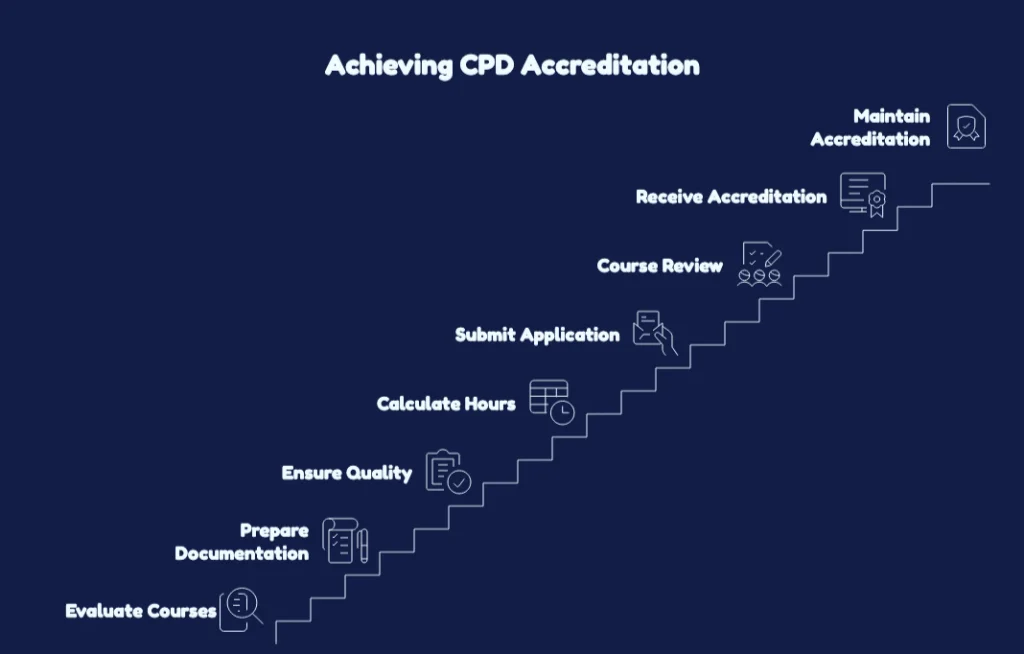
Step 1: Evaluate Your Existing Courses
Before you touch an application form, take an honest look at what you already have.
Ask yourself:
- Are the learning objectives clearly defined for each course?
- Does the course address a genuine, real-world professional need?
- Is the content current, accurate, and free of outdated practices?
- Is the course logically structured from start to finish?
- Can learners demonstrate measurable outcomes by the end?
If you can answer “yes” to most of these, you’re already in good shape to move forward. If not, this is the moment to strengthen the course rewriting objectives, updating content, or restructuring the flow rather than applying and hoping reviewers overlook the gaps. Accreditation bodies will notice, and addressing issues after a rejection almost always takes longer than fixing them upfront.
Step 2: Prepare Your Course Documentation
Documentation is where most of the real work happens, and it’s often the single biggest factor in how smoothly your application goes.
Most accreditation bodies will ask for details such as:
- Course title
- Course overview
- Learning objectives
- A detailed curriculum or syllabus
- Training duration
- Delivery method (online, in-person, hybrid)
- Assessment methods
- Trainer qualifications and experience
- Learning resources and materials used
Think of this documentation as the story of your course, told in a way a reviewer who has never seen it can fully understand. The more organized and complete this package is, the less back-and-forth you’ll need during review and the faster you’ll get approved. Providers who submit vague or incomplete documentation are almost always the ones who face delays.
A good habit here is to build a master template for course documentation that you can reuse and adapt every time you submit a new program. This saves significant time once you’re accrediting multiple courses.
Step 3: Ensure Your Content Meets Quality Standards
Quality matters far more than volume. A tightly structured three-hour course with strong learning outcomes will often outperform a bloated ten-hour course that meanders without clear direction.
Your course should:
- Have a logical progression from beginning to end
- Include practical, applicable learning rather than only theory
- Be engaging and interactive, not just a wall of slides or text
- Reflect current industry practices and standards
- Deliver outcomes that can actually be measured
It’s worth repeating: CPD accreditation is fundamentally about the quality of learning, not simply the number of hours logged. A provider that pads a course with filler content to inflate the CPD hour count is working against themselves reviewers are trained to spot this, and it can slow down or derail an otherwise strong application.
Step 4: Calculate CPD Learning Hours
Accreditation bodies typically want a clear, honest picture of how much genuine learning takes place during your course. This isn’t just about seat time it can include:
- Instructor-led teaching
- Self-paced learning modules
- Reading materials and pre-work
- Practical exercises and case studies
- Assessments and quizzes
- Reflection activities or post-course tasks
The key word here is realistic. It can be tempting to round up or overstate learning hours to make a course look more substantial, but accreditation bodies are experienced at spotting inflated numbers, and being transparent about your calculations builds trust rather than undermining your application.
Step 5: Submit Your Application
Once your course, documentation, and learning-hour calculations are in order, it’s time to formally apply. Applications generally require:
- Organization details
- Course information
- Supporting documents
- Sample learning materials
- Trainer profiles
- Quality assurance processes
Depending on the accreditation body and the nature of your courses, you may be asked for additional evidence for example, learner feedback data, sample assessments, or details of your internal review processes. Having these ready in advance, even if not initially requested, can speed things along if reviewers ask follow-up questions.
Step 6: Course Review and Assessment
After you submit, your application moves into the evaluation stage. Reviewers will typically assess:
- Educational quality
- Learning outcomes
- Relevance of the course to real professional needs
- Accuracy of content
- Adherence to professional standards
- Appropriateness of delivery methods
It’s common and completely normal for reviewers to come back with requests for clarification or minor improvements before granting approval. This isn’t a rejection; it’s part of the quality assurance process that makes accreditation meaningful in the first place. Respond to these requests promptly and thoroughly, since delays on your end will simply extend the review timeline.
Step 7: Receive Your CPD Accreditation
Once approved, you’ll typically receive some combination of:
- A CPD accreditation certificate
- A digital accreditation badge for your website and marketing materials
- Formal provider recognition
- Permission to display the accreditation logo, usually subject to specific branding guidelines
At this point, you can start actively promoting your accredited status. This is a good moment to update your website, course listing pages, marketing emails, and social channels to highlight the accreditation many learners specifically search for accredited training, so make sure this achievement is visible wherever prospective learners are making decisions.
Step 8: Maintain Your Accreditation
Accreditation isn’t a permanent, one-time achievement it’s an ongoing commitment. To maintain your status over time, you should:
- Regularly update course content to keep pace with industry changes
- Monitor learner feedback and act on it
- Continuously improve course quality
- Keep materials aligned with current developments in your field
- Renew your accreditation when required by the accrediting body
This ongoing effort actually reflects the entire point of Continuing Professional Development: learning doesn’t stop, and neither should your commitment to improving what you teach.
Common Mistakes to Avoid
Many first-time applicants unknowingly delay their own approval. The most frequent missteps include:
- Submitting incomplete or disorganized documentation
- Relying on outdated course content
- Leaving learning outcomes vague or poorly defined
- Overestimating learning hours
- Failing to provide evidence of assessments
- Ignoring quality assurance processes altogether
Avoiding these pitfalls alone can shave weeks off your accreditation timeline.
Tips for a Smooth Accreditation Process
To maximize your chances of a fast, successful approval:
- Organize all supporting documents before you begin the application
- Clearly define learning outcomes for every single course
- Keep your curriculum current and genuinely industry-relevant
- Make sure trainers have appropriate qualifications or demonstrable experience
- Maintain consistent quality standards across all your training programs
- Be transparent and realistic about course duration and learning hours
- Respond quickly to any requests for additional information during review
Final Thoughts
CPD accreditation is more than a quality mark to display on your website it’s a genuine commitment to delivering learning experiences that support real professional growth. For training providers, it builds trust with learners and employers, strengthens your credibility, and helps your programs stand out in an increasingly crowded education market.
The process does require careful preparation solid documentation, honest evaluation of your learning hours, and a willingness to refine your courses where needed but the long-term payoff is well worth the effort. By focusing on quality, clearly defined learning outcomes, and continuous improvement, you’ll be well positioned not just to achieve accreditation, but to keep it and to give your learners the recognized, career-enhancing education they’re looking for.