
Healthcare is constantly evolving. New technologies, treatment approaches, clinical practices, professional standards and workplace requirements mean that completing an initial qualification is only one part of a healthcare professional’s learning journey.
Continuing Professional Development (CPD) provides a structured way for professionals to maintain and develop their knowledge, practical skills and workplace competencies throughout their careers. CPD US describes CPD as an ongoing process focused on professional knowledge, technical expertise, workplace competency and career-focused skills.
But choosing a CPD course is not simply about finding a program that offers a certificate or a certain number of learning hours. Healthcare professionals have to consider whether the course is relevant to their role, whether the provider is credible, how the learning is assessed and whether the accreditation or recognition can actually be verified.
With so many healthcare CPD courses available, knowing what to look for can help you avoid investing your time and money in learning that does not meet your needs.
This guide explains how to evaluate CPD-accredited healthcare courses, verify accreditation claims and choose professional development that offers meaningful long-term value.
Why Not All CPD Courses Are Equal
The term CPD covers a broad range of professional learning activities. Courses can differ considerably in their learning objectives, content, assessment methods, delivery formats and quality-assurance processes.
A well-structured CPD course should have a clear purpose and explain what learners are expected to gain from the experience. For healthcare professionals, relevance is particularly important because learning needs can vary significantly between doctors, nurses, allied health professionals, healthcare administrators and other members of the healthcare workforce.
CPD US states that its recognition framework focuses on structured professional learning, qualification recognition and learner verification. Its quality standards also emphasize continuous improvement, professional accountability and periodic quality audits of approved providers.
This highlights an important point: a CPD certificate alone should not be the only factor you use to judge a course.
Understanding CPD Certification and Accreditation
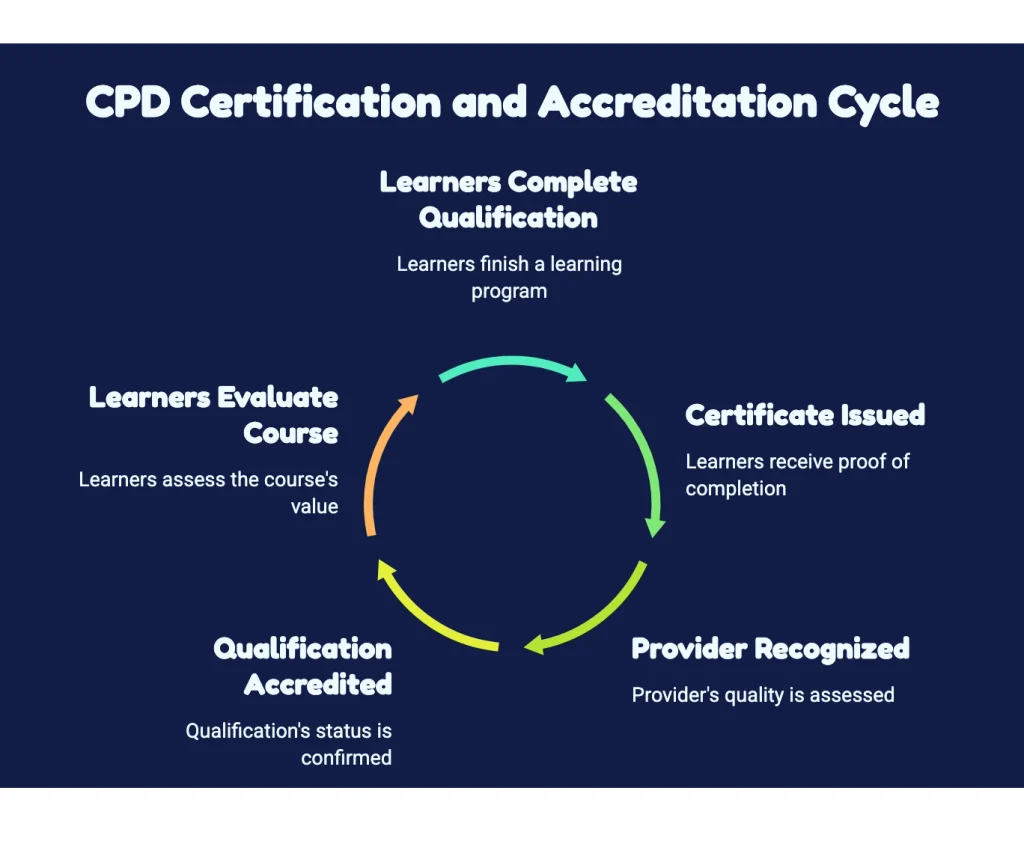
Certification and accreditation are often used together, but they can refer to different parts of the learning process.
A certificate can provide evidence that a learner completed a particular qualification or learning program. Accreditation or recognition, depending on the framework involved, relates to the quality, status or review of a provider, qualification or learning activity.
CPD US specifically distinguishes between CPD certification and CPD accreditation, explaining that they serve different purposes within professional learning.
When evaluating a course, therefore, look beyond the word “accredited.” Find out who is providing the recognition, what has been recognized and what the recognition actually means.
This distinction becomes particularly important in healthcare, where professional and regulatory requirements can vary between countries, professions and licensing bodies.
Red Flags to Watch for Before Enrolling
The growing number of online training providers makes it easier to find professional development opportunities, but it also means that learners need to evaluate claims carefully.
One warning sign is an accreditation claim that cannot be independently verified. If a provider displays an accreditation logo but does not clearly identify the organization behind it, investigate before enrolling.
Another concern is a lack of information about the actual course. A professional learning provider should explain the course content, intended audience and learning outcomes rather than focusing exclusively on the certificate.
Be Careful With Vague Recognition Claims
Phrases such as “internationally recognized” or “globally accredited” can sound impressive, but they do not tell you enough on their own.
Look for the name of the organization responsible for the recognition and determine whether you can independently verify the claim.
Look for Clear Learning Outcomes
A course should make it reasonably clear what learners are expected to understand, develop or apply after completing the training.
CPD US describes qualification transparency in terms of clear, verifiable learning outcomes mapped to professional learning requirements.
Examine the Assessment Process
Assessment is another important part of course quality.
Depending on the subject, assessment may involve structured activities, tests, assignments, case-based learning or other methods of evaluating understanding.
When comparing courses, ask whether the learning is actually assessed or whether a certificate is issued simply after completing the content.
Check Whether the Content Is Current
Healthcare knowledge does not remain static. Clinical practices, technologies and professional expectations can change.
A course should therefore provide enough information for you to understand whether its content is current and maintained.
How to Verify CPD Accreditation and Recognition
Once you find a course that appears relevant, the next step is verification.
Do not rely exclusively on information published by the training provider. If an accreditation or recognition claim is important to your decision, check the organization responsible for that recognition directly.
Start With the Accrediting or Recognizing Organization
Identify the exact organization named by the course provider.
Then visit the organization’s official website and look for information about its recognition framework, approved providers or registered qualifications.
CPD US, for example, provides a public Approved CPD Providers directory containing recognized institutions and information about their professional sectors and approved programs.
This kind of independent directory can help learners establish whether a provider appears within the relevant recognition system.
Check Whether the Provider Is Recognized
CPD US also provides a Provider Verification portal. Users can search using information such as the provider name, CPD Provider ID or organization email.
The verification record can include the institution’s recognition status, recognition type, registration information, professional sectors, effective date and expiry date.
This is useful because it moves verification beyond a logo or statement on a course webpage.
Check What Exactly Is Recognized
A crucial step is determining whether recognition applies to the provider, qualification or specific learning program.
These are not necessarily the same.
CPD US offers institution-level provider recognition as well as qualification recognition. Its qualification-recognition service includes qualification review, learner verification support and a qualification verification ID.
Therefore, do not assume that every course offered by a provider automatically has identical recognition status. Check the specific information relevant to the course you are considering.
Check the Recognition Status and Dates
Where a verification system provides effective and expiry dates, check them.
The purpose is simple: you want to know whether the recognition you are relying on is current at the time you make your decision.
How to Verify a CPD Certificate
Verification should not necessarily stop when you finish the course.
A useful CPD system should allow credentials to be authenticated after completion, particularly when certificates may need to be presented to employers, institutions or other organizations.
CPD US provides a Candidate Verification Portal designed to verify individual learner achievements. Users can search using a certificate number, candidate name or qualification registration number.
The system can display information such as the qualification title, completion status, institution, qualification level, professional sector, date of issue and verification status. CPD US also describes QR-enabled certificates that can connect directly to its verification system.
For healthcare professionals, this type of verification can provide an additional layer of transparency when maintaining professional records or demonstrating completed learning.
However, verification should not be confused with regulatory approval. CPD US explicitly states that verification confirms the existence of a learner record within its system but does not constitute government licensing, employment authorization or regulatory approval.
Check the Provider’s Credibility Before Enrolling
Accreditation is only one part of evaluating a course. You should also consider the organization delivering the training.
Start with the provider’s background. Look for clear information about its purpose, professional focus, contact details and experience.
Instructor expertise can also provide useful context. Where information is available, review the qualifications and professional background of the people developing or delivering the course.
Independent reviews can help you understand the learner experience, but do not rely entirely on testimonials displayed on the provider’s own website.
You can also check whether the provider appears in an independent recognition directory. CPD US’s approved-provider directory, for example, allows users to identify recognized institutions across different professional sectors.
Transparency should continue beyond enrollment. Consider whether the provider explains how qualifications are issued, how learners can verify their certificates and how learner support is provided.
Choose CPD Based on Competency, Not Just Points
One of the most common mistakes when selecting CPD is treating professional development as a numbers exercise.
CPD hours or points may be relevant to particular professional requirements, but the number alone does not tell you whether a course is useful for your role.
Start by identifying what you actually need to learn.
A doctor may be looking for specialty-specific education. A nurse may need development related to clinical practice, patient care or changing professional standards. A healthcare administrator may need training in management, quality systems or healthcare operations.
The course should connect with your professional responsibilities and development goals.
Match Learning to Your Role
Before enrolling, consider whether the subject is directly relevant to your current responsibilities.
A course that provides fewer learning hours but addresses an important competency gap may be more useful than a longer course with little relevance to your work.
Think About Application
The strongest CPD choices should provide learning that can be applied beyond the course itself.
Consider whether the content can improve your knowledge, support workplace competency or help you adapt to developments within your field.
CPD US describes its healthcare framework as supporting medical practice, patient care systems, nursing education, healthcare administration and clinical workforce competency development.
This broad scope also demonstrates why healthcare CPD should be considered according to the learner’s specific role rather than as a one-size-fits-all requirement.
Consider Cost Against Overall Value
Price is naturally part of the decision, particularly for professionals paying for their own education or organizations managing staff development budgets.
However, price alone does not establish quality.
Instead, compare what you are receiving for the investment.
Consider the quality and depth of the learning materials, assessment methods, instructor expertise, recognition status, learner support and certificate-verification options.
You should also look for potential additional costs, including assessments, resits, learning materials or certificate services.
CPD US currently separates provider recognition, qualification recognition and candidate verification into different service categories, illustrating that professional learning can involve several distinct elements rather than a certificate alone.
The most useful question is therefore not simply “How much does the course cost?” but “What professional value do I receive for the time and money I invest?”
Choose the Right CPD Learning Format
Healthcare professionals have different schedules, responsibilities and learning preferences, so course format should also be considered.
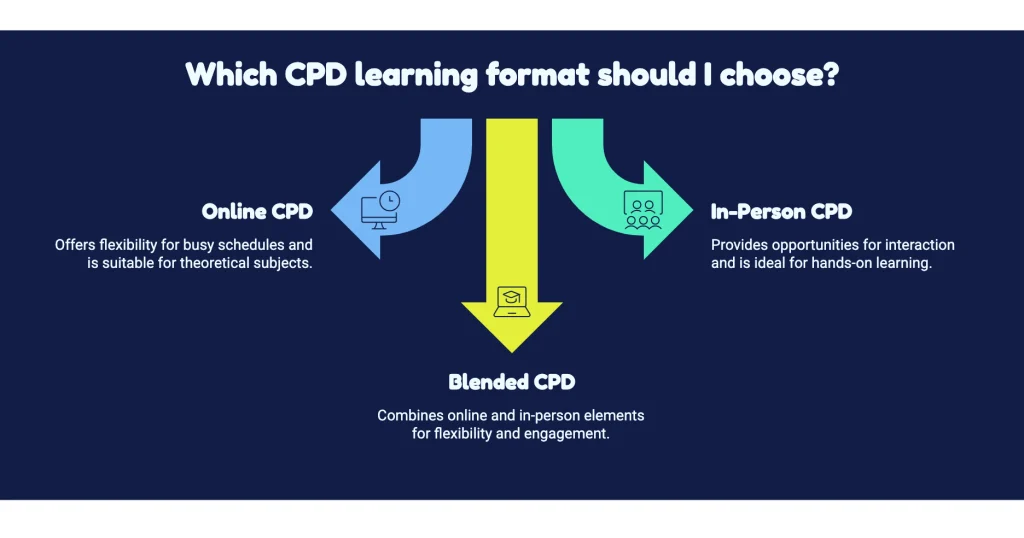
Online CPD
Online learning can provide flexibility for professionals working shifts or managing demanding schedules. It can be particularly suitable for theoretical and knowledge-based subjects.
CPD US confirms that online-only institutions can apply within its recognition framework if they operate structured professional learning systems.
In-Person CPD
Face-to-face learning can provide opportunities for discussion, interaction, demonstrations and practical activities.
For subjects where hands-on experience is important, the physical learning environment may be particularly relevant.
Blended CPD
Blended learning combines online learning with interactive or face-to-face elements.
This can provide flexibility while retaining opportunities for practical engagement. However, the quality depends on how effectively the different components are designed and connected.
The delivery format itself should not be treated as a guarantee of quality. Instead, evaluate the learning objectives, content, assessment and practical relevance of the course.
For a deeper comparison, link this section to your Online vs In-Person CPD article.
Understand the Long-Term Value of Quality CPD
The purpose of CPD extends beyond obtaining another certificate.
Healthcare professionals need to continue developing their knowledge and workplace competencies as professional environments change.
CPD US positions continuing professional development around lifelong learning, industry-relevant skills, professional recognition and workforce development.
Choosing relevant, credible learning can therefore contribute to a more structured professional development record and help professionals remain engaged with developments in their field.
For employers and L&D managers, the same principle applies. Training should be connected to workforce competency and organizational needs rather than selected simply because it is inexpensive or easy to complete.
Quality CPD can support professional development, but it should not be presented as a guarantee of promotion, salary increases or licensing outcomes. CPD US itself notes that recognition does not automatically constitute government accreditation, professional licensing approval or degree-granting authority.
Professionals should therefore always check the requirements of their own regulator, licensing authority, employer or professional body where applicable.
Make Your CPD Choice With Confidence
Choosing a CPD course becomes easier when you have a clear evaluation process.
Start by identifying your professional development needs. Then examine the course content, learning objectives and assessment methods.
Next, investigate the provider and independently verify any accreditation or recognition claims. Check whether the provider or qualification appears in an official directory and whether verification information is available.
Before enrolling, also consider the delivery format, total cost, learner support and long-term relevance of the learning.
Most importantly, do not choose a course simply because it promises a certificate or a large number of CPD points. A meaningful CPD experience should contribute to ongoing professional learning, relevant competencies and workforce development.
For healthcare professionals, making a careful choice can turn CPD from a routine requirement into a structured part of lifelong professional development.
Explore verified CPD-accredited healthcare courses and find learning aligned with your professional development goals.