
In today’s rapidly changing professional landscape, learning does not end when a qualification is completed. New technologies, evolving regulations, changing customer expectations and emerging business models continuously reshape the skills professionals need to succeed. For organizations, this creates an equally important challenge: how can they ensure that learning remains relevant, structured and connected to real workplace needs?
This is where Continuing Professional Development (CPD) becomes increasingly valuable.
CPD provides a structured approach to maintaining and improving professional knowledge, practical skills and workplace competency throughout a career. Rather than treating professional learning as a one-time achievement, a CPD framework encourages continuous development and lifelong learning.
The versatility of the CPD framework is one of its greatest strengths. While the fundamental purpose remains consistent supporting continuous professional growth the way CPD is implemented can differ across industries, professions and certification bodies. From financial risk management and compliance to contract management and teacher education, professional organizations use CPD structures to encourage relevant and measurable development.
For organisations and professionals, this creates an opportunity to move beyond simply completing training hours and toward building meaningful, future-ready capabilities.
Deconstructing the Core Architecture of the CPD Framework
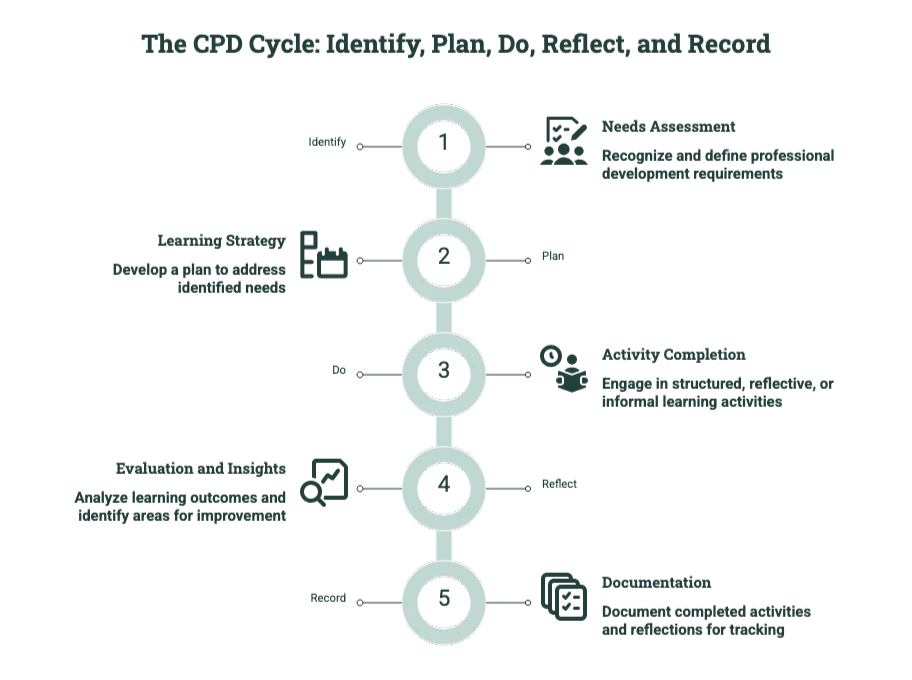
A strong CPD framework is built around a continuous process of identifying development needs, planning learning, completing relevant activities, and reflecting on the results.
The CPD Cycle: Identify, Plan, Do, Reflect and Record
The CPD cycle provides a practical structure for professional development.
First, professionals identify their current skills, knowledge and development gaps. They can then plan learning activities that address those needs. The next stage is to do putting the planned learning into practice through activities such as training, workshops, courses, conferences or professional projects.
The final stages, reflect and record, are particularly important. Completing a course is not necessarily the end of the learning process. Reflection helps professionals consider what they learned, how it applies to their role and what they should develop next.
This cycle transforms professional development from a collection of disconnected activities into a continuous process.
For training organizations, structured qualification recognition can further support this approach by providing a framework around learning structure, professional relevance, assessment and learner progression.
CPD is not limited to classroom-based education.
Professional development can include structured learning such as workshops, seminars, accredited courses and formal training. It can also involve reflective learning, including reviewing professional experiences, listening to industry discussions or considering lessons from completed projects.
Structured, Reflective and Informal Learning
Informal and self-directed learning can also contribute to professional development. Reading industry publications, participating in professional discussions, researching emerging technologies and learning from experienced colleagues can all help professionals remain current.
The balance between these forms of learning varies between professional organizations. For example, The CPD Certification Service recommends that professionals make substantial use of structured learning, but such recommendations should not be treated as a universal requirement for every profession.
The important principle is that CPD should contribute meaningfully to professional growth rather than becoming a simple exercise in collecting certificates.
Understanding CPD Points, Hours and Credits
CPD systems often use hours, points or credits to help professionals document their learning.
A commonly used convention is that one CPD point or credit may represent approximately one hour of eligible learning. However, this is not a universal conversion rule. Professional associations and regulatory bodies can apply their own weighting systems to different types of learning.
This distinction matters because CPD frameworks are designed to be adaptable. A learning activity that receives a particular value under one professional body’s system may be assessed differently by another.
Therefore, professionals should always check the requirements of the organization, certification or regulator relevant to their field.
The CPD Framework in Action Across Global Industries
The versatility of CPD becomes particularly clear when looking at how different professional organizations structure continuing development.
Financial Risk Management and Emerging Technology
Financial professionals operate in an environment where markets, regulations and technologies change rapidly. Risk professionals must therefore continue developing their understanding of areas such as financial markets, sustainability, technology and emerging risks.
The Global Association of Risk Professionals (GARP), for example, uses defined CPD requirements for professionals holding its certifications. FRM and ERP certification holders are expected to complete 40 CPD credits over a 24-month cycle, while SCR and RAI certificate holders have different requirements.
These requirements demonstrate an important characteristic of CPD: the framework can maintain a consistent commitment to ongoing learning while allowing the content and measurement of development to reflect a specific professional field.
Banking, Compliance and Financial Crime
Banking and compliance professionals face constantly changing regulations, financial crime risks and governance expectations.
Professional bodies such as the Indian Institute of Banking & Finance (IIBF) and the International Compliance Association (ICA) use continuing development requirements to encourage professionals to maintain relevant knowledge.
For example, IIBF has specific CPD requirements for its registered members, while ICA recommends annual CPD learning for its professional membership levels. ICA also allows certain learning completed through other recognized professional bodies to count toward its CPD requirements.
These examples highlight why CPD should not be viewed as a single universal checklist. Different professional environments require different forms of continuing education.
Commercial and Contract Management
Contract and commercial professionals must keep pace with changing business practices, negotiation approaches, technology and organizational requirements.
World Commerce & Contracting (WorldCC), for example, uses annual CPD requirements that vary according to certification level. Associate certification requires fewer annual points than its higher Practitioner, Advanced Practitioner and Expert levels.
The principle remains consistent: as professional responsibility and specialization increase, continuing development can become more structured and advanced.
HR and Strategic People Development
Human resources professionals operate at the intersection of people, technology, organizational strategy and workplace culture.
For this sector, CPD is not simply about technical knowledge. It can include leadership, employee development, organizational effectiveness, professional behaviours and strategic people management.
The Chartered Institute of Personnel and Development (CIPD), for example, provides professional development structures designed around the capabilities expected of people professionals.
This demonstrates how CPD can extend beyond technical skills to support broader professional competency.
Teacher Education and Pedagogy
Education provides another example of sector-specific CPD.
The British Council’s framework for teacher educators uses four progressive development areas: Foundation, Engagement, Integration and Specialisation.
Rather than applying a generic professional-development model to educators, the framework reflects the particular capabilities required within teacher education.
This is the real versatility of CPD: the underlying principle of continuous improvement remains consistent while the framework can be adapted to the professional context.
The Critical Role of Independent CPD Accreditation and Trustmarks
For organizations that provide professional education, simply offering a course is not always enough. Learners and employers increasingly want greater transparency around the quality, structure and professional relevance of training.
This is where CPD accreditation and provider recognition can become important.
Provider recognition focuses on the organization delivering professional learning, while qualification recognition focuses on individual courses, certifications or learning programs.
A qualification-level framework can examine areas such as learning structure, professional relevance, assessment processes, competency development and learner progression.
Independent quality processes can therefore help training providers demonstrate that their educational offering follows an organized professional-development framework.
However, accreditation should not automatically be interpreted as government licensing, degree accreditation or a guarantee of employment or professional licensing. Requirements differ between countries, industries and regulators.
For training organizations, transparency is therefore essential. Clear quality standards, recognizable credentials and accessible verification processes can help strengthen trust between providers, learners and employers.
From Compliance to Competitive Advantage
The greatest value of CPD appears when organizations stop treating professional development as a simple compliance exercise.
A “tick-box” approach focuses on whether employees completed the required activity. A development-focused approach asks a more important question:
Did the learning improve capability?
Moving Beyond the Tick-Box Mentality
Organizations can use CPD to connect individual learning with actual business objectives.
For example, a technology company introducing artificial intelligence may need employees to develop new technical and ethical capabilities. A financial organization may need stronger risk and compliance knowledge. A healthcare organization may need professionals to remain current with evolving practices.
In each case, CPD can become a mechanism for identifying skills gaps and directing learning toward practical outcomes.
Building Trust Through Credential Verification
As professional learning becomes increasingly digital, verification also becomes more important.
A digital verification system can help employers and other stakeholders confirm whether a qualification or credential is authentic. CPD describes its Candidate Verification system as supporting qualification authenticity and public trust.
This is particularly relevant in a global learning environment where certificates may be earned online and presented to employers across different regions.
Verification does not replace professional licensing or regulatory approval, but it can provide an additional layer of transparency around learning credentials.
Aligning Learning with Workforce Development
Modern organisations need more than employees who can complete training. They need people who can adapt.
Workforce development connects professional learning with organisational capability, including technical skills, leadership, communication, operational performance and adaptability.
CPD positions workforce development as part of its professional learning approach, Emphasizing competency and career-focused learning for modern enterprises.
The result is a shift in perspective: CPD becomes not just something professionals complete, but a tool organizations can use to build future-ready workforces.
The Versatile Edge of CPD
The strongest feature of the CPD framework is not that every profession follows exactly the same requirements.
It is the opposite.
CPD provides a common philosophy continuous professional growth while allowing professional bodies, industries and organisations to determine what meaningful development looks like in their own environment.
A risk professional may focus on financial risk and emerging technology. A compliance professional may concentrate on regulatory change and financial crime. A contract manager may develop negotiation and commercial capabilities. A teacher educator may focus on pedagogy and professional learning.
The framework adapts while maintaining the central objective of keeping professional knowledge and capability moving forward.
For training providers, this adaptability creates an opportunity to demonstrate quality and relevance. For employers, it provides a structure for developing workforce capability. And for professionals, it creates a pathway for lifelong learning.
According to figures displayed on the CPD Professional Portal, its platform has published more than 40,000 CPD providers, courses and events, supports providers in more than 100 countries, and displays a figure of more than 500,000 certificates issued. These are CPD’s own platform figures rather than independently verified industry statistics.
Ultimately, the value of CPD lies in turning learning into continuous professional growth. When supported by appropriate standards, meaningful assessment, quality assurance and transparent verification, CPD can help professionals and organizations remain capable, credible and prepared for what comes next.