
Healthcare is an industry that never stops changing. New treatments are introduced, technologies evolve, clinical practices are updated, and professional standards continue to develop. For healthcare professionals, earning a qualification is only the beginning of a lifelong learning journey.
This is why CPD in healthcare has become an important part of professional practice. Continuing Professional Development, or CPD, gives healthcare professionals a structured way to keep their knowledge and skills current throughout their careers. In many healthcare systems, CPD is also connected to professional registration, licensing, and renewal requirements.
Whether you are a newly qualified professional or have years of experience, understanding CPD can help you stay prepared, meet professional expectations, and make your ongoing learning more meaningful.
What Is CPD in Healthcare?
Understanding Continuing Professional Development in Healthcare
Continuing Professional Development is the ongoing process of developing professional knowledge, skills, and competence after completing initial education or training.
In healthcare, this can include learning about new treatments, improving clinical skills, understanding updated professional guidance, developing communication abilities, or gaining knowledge in areas such as leadership and healthcare technology.
CPD is not limited to attending a classroom course. Healthcare professionals can learn through workshops, conferences, webinars, online courses, workplace training, professional discussions, self-directed study, and reflective learning.
The purpose is to ensure that professional development continues throughout a healthcare career rather than stopping when an initial qualification is completed.
For example, a nurse may complete training on updated wound-care practices. A pharmacist may learn about new medicines or drug interactions. A doctor may undertake education related to developments in their area of practice. A healthcare manager may develop skills in leadership, administration, or quality improvement.
These activities may look different, but they share the same basic purpose: continuous professional learning that remains relevant to the individual’s role.
Why Is CPD Different in Healthcare?
CPD is important in many industries, but healthcare has a particular responsibility because professionals work directly with patients and communities.
Healthcare knowledge can change quickly. A professional who relies only on knowledge gained during their original education may eventually find that some information, practices, or technologies have changed.
Continuing professional development provides a way to keep learning and adapting.
It also encourages professionals to think about their own development. Instead of simply completing training because it is required, effective CPD involves identifying areas for improvement, choosing relevant learning, applying new knowledge, and considering how that learning contributes to professional practice.
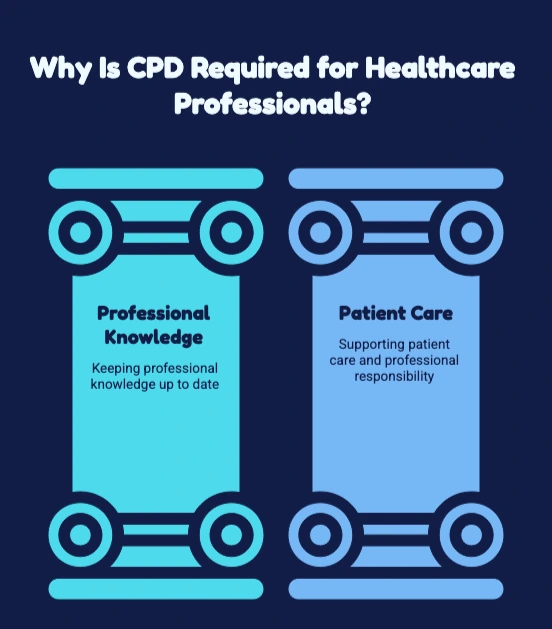
Why Is CPD Required for Healthcare Professionals?
Keeping Professional Knowledge Up to Date
One of the main reasons for CPD requirements in healthcare is the need to maintain current professional knowledge and skills.
Healthcare professionals may encounter new technologies, updated procedures, emerging treatments, changing guidelines, and evolving expectations throughout their careers.
Regular learning helps professionals respond to these changes and continue developing within their area of practice.
CPD should therefore be viewed as an ongoing process rather than a one-time requirement. The objective is not simply to complete a certain number of learning activities but to support continued professional development.
Supporting Patient Care and Professional Responsibility
Healthcare professionals have an important responsibility to maintain their competence and provide appropriate care within their scope of practice.
CPD can support this responsibility by giving professionals opportunities to update their knowledge and develop relevant skills.
For example, learning about a new clinical procedure may help a professional understand current approaches in their field. Training in communication may help improve interactions with patients and colleagues. Learning about new healthcare technology may help professionals adapt to changes in their workplace.
CPD does not automatically guarantee better patient outcomes, but it provides a framework for continuous learning that can contribute to professional practice.
CPD and Professional Registration
For many healthcare professionals, CPD is closely connected to professional registration or renewal.
Regulatory bodies may require registered professionals to demonstrate ongoing professional development as part of maintaining their registration. The exact requirements depend on the profession and jurisdiction.
For example, the Health and Care Professions Council (HCPC) in the UK identifies CPD as a requirement of registration for its registrants. Professionals are expected to undertake regular CPD, maintain records, and reflect on how their learning affects their practice.
Other professional regulators use their own systems for CPD hours, points, activities, reflection, or evidence.
This means healthcare professionals should always understand the rules that apply to their specific profession rather than assuming that one CPD requirement applies to everyone.
Understanding CPD Requirements in Healthcare
CPD Requirements Vary by Profession and Country
There is no single CPD system for every healthcare professional around the world.
Doctors, nurses, pharmacists, dentists, physiotherapists, and other allied health professionals can have different professional development requirements. These requirements may also differ between countries and regulatory authorities.
Some systems require professionals to complete a specified number of CPD hours during a particular period. Others may use points or credits, while some focus more strongly on maintaining evidence of learning and demonstrating reflection.
For this reason, there is no universal number of CPD hours that every healthcare professional must complete.
The World Federation for Medical Education recognizes that CPD systems vary across different countries and healthcare environments. The structure, requirements, and approaches to professional development can therefore depend on the local regulatory framework.
Understanding this difference is essential when researching CPD requirements healthcare professionals need to follow.
What About Nurses, Doctors, Pharmacists, and Other Roles?
Although the basic purpose of CPD is similar across healthcare, the learning requirements can be closely related to each professional’s role.
Nurses may undertake development related to patient care, clinical skills, communication, specialist nursing areas, safety, or leadership.
Doctors may participate in continuing medical education and other professional development activities connected to their clinical practice and areas of specialization.
Pharmacists may focus on medicines, patient safety, drug interactions, new treatments, and developments in pharmacy practice.
Dentists may undertake learning related to clinical techniques, dental technology, patient care, and professional standards.
Allied health professionals may have CPD requirements based on their specific profession, scope of practice, and regulator.
These differences are why profession-specific CPD guides can be useful. A general healthcare CPD guide explains the overall system, while dedicated resources for nurses, doctors, pharmacists, and other professionals can explore their individual requirements in greater detail.
How Does CPD Work in Healthcare?
Earning CPD Hours, Points, or Credits
Depending on the relevant system, healthcare professionals may receive CPD hours, points, credits, or evidence of completed learning for eligible activities.
A professional might attend an educational event, complete an online course, participate in a workshop, or undertake another approved learning activity. The activity may then contribute towards their CPD requirements if it meets the rules of their professional body.
However, CPD points and hours do not work in exactly the same way everywhere.
A healthcare professional should therefore check how their regulator defines CPD and which activities are eligible before relying on a course or event to meet a registration requirement.
The safest approach is to keep a record of each completed activity, including the date, subject, provider, duration where relevant, and supporting evidence.
Common Types of Healthcare CPD
Healthcare CPD can involve many different forms of learning.
Structured learning may include courses, seminars, conferences, workshops, webinars, and professional training programs. These activities usually have defined learning objectives and an organized format.
Self-directed learning can include reading professional literature, studying relevant guidance, researching a topic, or independently developing knowledge related to professional practice.
Workplace learning can also contribute to professional development. This may include training sessions, professional discussions, learning from colleagues, or activities designed to improve workplace skills.
Reflection is another important part of CPD. Professionals can consider what they learned, why it was relevant, and how it may influence their work.
The most appropriate activities depend on the individual’s role and the requirements of their professional regulator.
The Healthcare CPD Cycle
CPD is often easier to understand when viewed as a continuous cycle rather than a collection of individual courses.
The process can begin by identifying a learning need. A professional may realize that they need to update their knowledge, improve a particular skill, or learn about a development in their field.
The next step is planning. The professional chooses suitable learning activities based on their role and development needs.
They then complete the learning and record the relevant details. Where appropriate, they can reflect on what they learned and consider how it can be applied to their professional practice.
Finally, they review their progress and identify future learning needs.
This creates a continuous cycle of identify, plan, learn, reflect, record, and review.
The cycle can be repeated throughout a professional’s career, allowing CPD to develop alongside changes in the healthcare environment and the individual’s responsibilities.
Tracking and Documenting Your CPD
Why CPD Records Matter
Completing professional development is important, but keeping evidence of that development can be equally important.
Healthcare professionals may need to demonstrate their CPD during registration renewal, professional audits, or other regulatory processes.
A CPD record makes it easier to show what learning has been completed and how it relates to professional development.
Instead of waiting until the end of a renewal period, professionals can maintain their records throughout the year or CPD cycle.
What Should a CPD Record Include?
The exact documentation requirements depend on the relevant regulator, but a professional record may include details such as the name of the learning activity, date of completion, provider, duration, learning outcomes, and evidence of participation.
Certificates can be useful evidence, but they are not always the only thing that matters. Some regulatory systems may also require reflection or an explanation of how learning relates to professional practice.
For this reason, maintaining a simple and organized CPD portfolio can make the renewal process easier.
Understanding the CPD Renewal Cycle
A CPD renewal cycle is the period during which a professional is expected to complete and document their required development activities.
The length of this period can vary. Some professional systems operate annually, while others use longer registration cycles.
As the renewal period approaches, professionals may need to review their records and ensure that they have met the requirements applicable to their registration.
The important thing is to avoid treating CPD as something that only needs attention immediately before renewal. Maintaining records continuously makes it easier to monitor progress and identify any gaps in learning.
Choosing Quality CPD
Why the Quality of Learning Matters
Completing CPD is not simply about accumulating certificates. The learning should be relevant, useful, and appropriate for the professional’s development needs.
Before choosing a course, healthcare professionals can consider whether the subject is relevant to their role, whether the learning objectives are clear, and whether the provider has a credible approach to professional education.
High-quality CPD should provide a clear connection between the learning activity and the skills or knowledge it aims to develop.
CPD Provider and Qualification Recognition
Organizations that provide professional education can also seek recognition for their learning programs.
CPD offers CPD Provider Recognition for organisations delivering professional learning and CPD Qualification Recognition for individual courses and qualifications. These recognition frameworks focus on areas such as learning structure, professional relevance, learning outcomes, and educational quality.
For healthcare professionals, this can provide another factor to consider when evaluating professional learning opportunities.
However, CPD recognition should not be confused with professional licensing or statutory healthcare registration. Whether a specific learning activity meets a mandatory regulatory requirement depends on the rules of the relevant professional authority.
CPD Verification and Professional Transparency
As professional education increasingly moves online, verifying learning records can become an important part of maintaining transparency.
Healthcare professionals may receive certificates from different organizations and educational providers. Employers and other organizations may sometimes need to confirm whether a professional learning achievement is genuine.
CPD provides online verification services that allow registered learning achievements and provider recognition status to be checked.
This type of verification can support transparency around professional learning and help organizations make more informed decisions when reviewing educational credentials.
Again, verification does not replace a professional regulator’s registration system. It serves a different purpose by supporting the authentication and transparency of recognized CPD records.
CPD in Healthcare and Workforce Development
CPD is not only important for individual professionals. It can also support healthcare organizations in developing their workforce.
Hospitals, clinics, care organizations, and other healthcare employers operate in environments where employees need to adapt to new systems, technologies, procedures, and professional expectations.
A structured approach to workforce learning can help organizations create a culture where professional development becomes part of everyday working life.
For employers, CPD can also help organize learning around broader workforce needs. Different teams may require different development priorities, from clinical knowledge and technical skills to communication, leadership, administration, and digital capabilities.
This makes continuing professional development relevant at both the individual and organizational level.
Making CPD Part of a Healthcare Career
The most effective approach to CPD is to treat it as an ongoing part of professional life rather than a task completed only because a renewal deadline is approaching.
Healthcare professionals can regularly consider what they know, what has changed in their field, where they need to improve, and what learning would be most useful.
This approach makes CPD more meaningful. Instead of asking only, “How many CPD points do I need?”, professionals can also ask, “What do I need to learn to become better at my role?”
That shift can turn CPD from an administrative requirement into a valuable professional habit.
Building a Culture of Continuous Professional Development
CPD in healthcare plays an important role in helping professionals continue learning throughout their careers. From clinical knowledge and technical skills to communication, leadership, and workplace development, CPD can take many different forms.
For some healthcare professionals, CPD is also an important part of maintaining professional registration and meeting renewal requirements. However, the exact rules vary between professions, countries, and regulatory bodies.
Understanding your specific requirements, choosing relevant learning activities, keeping accurate records, and regularly reflecting on your development can make the entire CPD process easier to manage.
For healthcare organizations and education providers, structured CPD frameworks can also support workforce development and provide greater transparency around professional learning.
CPD supports this broader approach through provider recognition, qualification recognition, verification, quality frameworks, and workforce learning solutions.
Ultimately, continuing professional development is about more than completing hours or collecting certificates. It is about staying curious, keeping professional knowledge current, and continuing to grow as healthcare evolves.
If you are a healthcare professional looking to understand CPD requirements or an organization developing professional learning programs, exploring a structured CPD approach can be a valuable step toward supporting continuous development and professional growth.