
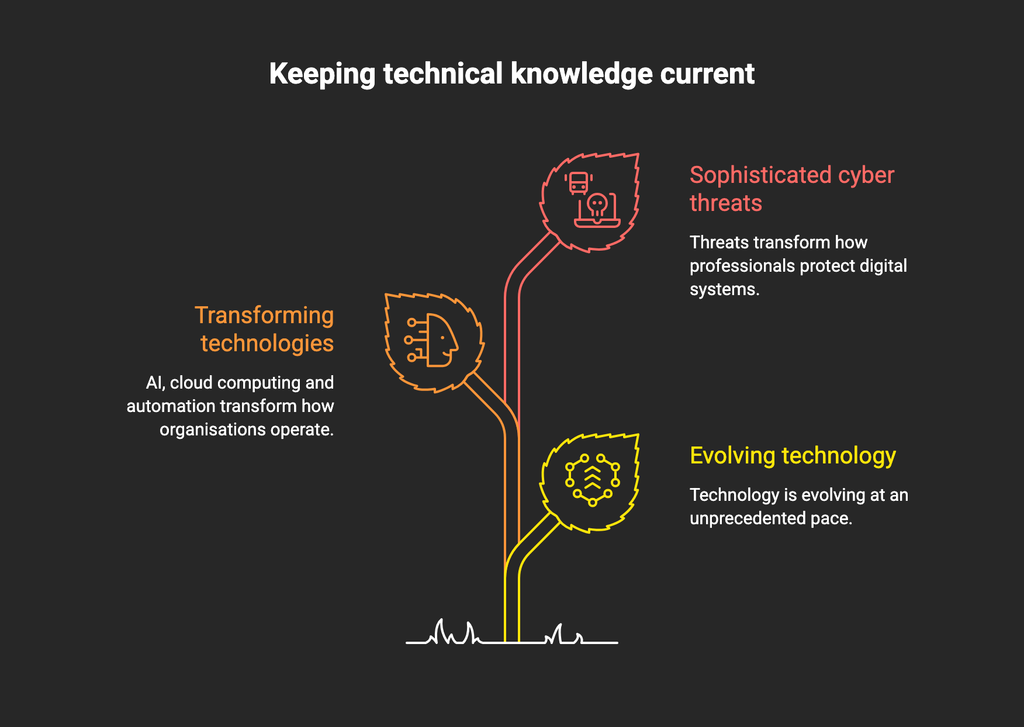
Technology is evolving at an unprecedented pace. Artificial intelligence, cloud computing, automation and increasingly sophisticated cyber threats are transforming how organisations operate and how professionals protect digital systems. For IT and cybersecurity professionals, keeping technical knowledge current is no longer optional. It is essential for maintaining professional competence, responding to new challenges and supporting organisational resilience.
CPD for IT professionals provides a structured approach to continuous learning, helping individuals update their knowledge, develop practical skills and respond to changing industry requirements. Similarly, CPD for cybersecurity supports ongoing development in areas such as threat intelligence, incident response, cloud security and information security management.
Continuing Professional Development (CPD) is relevant not only to individual professionals but also to training providers and organisations that want to demonstrate a commitment to quality learning. By supporting relevant, structured development, CPD can help the technology workforce remain prepared for emerging opportunities and risks.
Why CPD Matters for IT and Cybersecurity Professionals
The technology sector changes too quickly for initial qualifications or past experience alone to guarantee continued competence. Tools, platforms, regulations and security practices evolve, making ongoing learning an important part of professional development.
Responding to Rapid Technological Change
New technologies can change how IT systems are developed, maintained and secured. Artificial intelligence is influencing software development and security monitoring, while cloud platforms continue to reshape infrastructure management. Professionals who rely only on previously acquired knowledge may struggle to adapt as these technologies become more widely adopted.
CPD helps professionals review their existing capabilities, identify areas for improvement and develop knowledge relevant to current responsibilities. Learning can take place through formal training, technical workshops, webinars, industry events and practical projects.
Addressing the Cybersecurity Skills Gap
Cybersecurity teams face continuing challenges as attack methods become more sophisticated. Phishing, ransomware, credential theft, supply-chain vulnerabilities and attacks against cloud environments require professionals to understand current risks and appropriate defensive measures.
Ongoing learning can help professionals strengthen their understanding of emerging threats, improve incident response and make better-informed security decisions. It can also help organisations identify capability gaps and plan workforce development more effectively.
Supporting Career Development
CPD is not limited to learning new technical tools. It can also develop communication, leadership, problem-solving, risk assessment and decision-making skills.
These capabilities are valuable for professionals moving into senior technical positions, security management, consultancy or governance-related responsibilities. A structured development record can also help individuals demonstrate how they maintain and improve their professional knowledge.
Ultimately, CPD encourages lifelong learning by treating professional development as an ongoing process rather than a task completed after gaining a qualification.
Emerging Technology Trends That Make CPD Essential
To remain effective, IT and cybersecurity professionals need to understand the technologies and risks influencing their fields. CPD activities can help them explore these developments and assess their relevance to their roles.
Artificial Intelligence and Security
Artificial intelligence is increasingly used in software development, data analysis, security monitoring and threat detection. These applications can improve efficiency, but they also introduce challenges involving data privacy, model vulnerabilities, misuse and the reliability of automated decisions.
Cybersecurity professionals need to understand how AI may be used by both defenders and attackers. IT professionals may also benefit from learning about secure AI integration, data governance and responsible implementation.
Relevant CPD activities could include technical workshops, guided learning on AI security, case-study analysis and training on emerging AI-related risks.
Cloud Security
Cloud computing has changed how organisations store information, deploy applications and manage infrastructure. However, cloud environments introduce security considerations involving identity and access management, configuration, data protection and shared responsibility.
CPD can help professionals update their understanding of cloud security controls, monitoring practices, access policies and incident response procedures. Training should reflect the platforms and responsibilities relevant to the learner’s role.
Zero Trust and Identity Management
Zero trust security is based on the principle that access should not be granted solely because a user or device is inside a network. Access decisions should consider identity, permissions, device conditions and other relevant security signals.
Professionals may need to develop knowledge of multifactor authentication, least-privilege access, identity governance and continuous monitoring. CPD can help them understand these principles and assess how they apply within their organisations.
Threat Intelligence and Incident Response
Threat intelligence helps security teams understand potential attackers, their techniques and the risks facing their organisations. Incident response focuses on preparing for, identifying, containing and recovering from security incidents.
Regular development in these areas can help professionals interpret threat information, improve response procedures and learn from previous incidents. Practical exercises and scenario-based training can be particularly useful because they allow learners to apply knowledge in realistic situations.
Information Security Management and ISO 27001
Technical controls are only one part of effective information security. Organisations also need appropriate policies, risk assessments, documented procedures and processes for continual improvement.
Knowledge of ISO 27001 and information security management systems can help relevant professionals understand how information security risks are identified, managed and reviewed. CPD in this area may be useful for IT managers, security practitioners, auditors and professionals involved in governance or compliance.
The appropriate learning pathway depends on an individual’s responsibilities and the requirements of their organisation.
What Counts as CPD for IT Professionals and Cybersecurity?
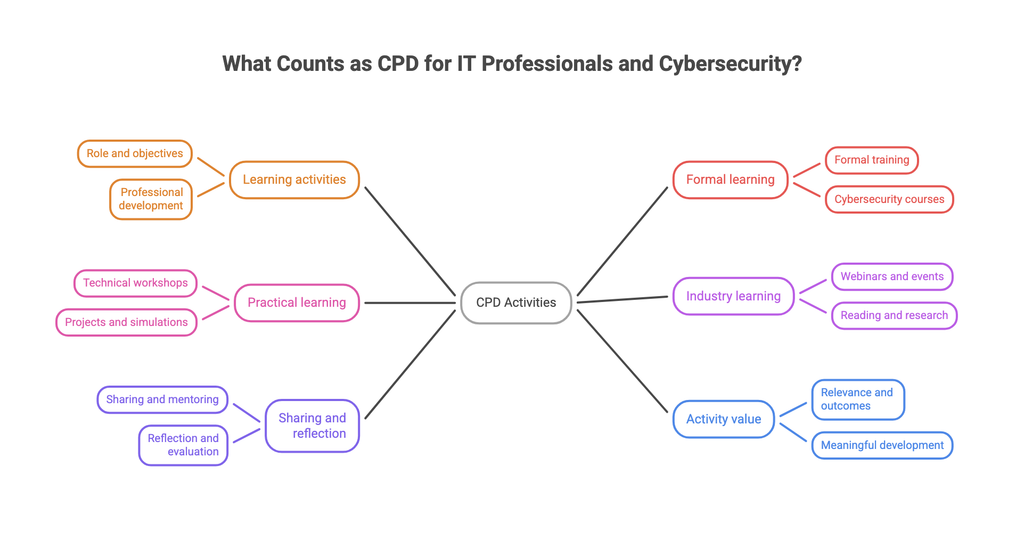
CPD can include a range of learning activities, provided they contribute meaningfully to professional development. The most suitable activities depend on the learner’s role, experience and development objectives.
Examples include:
- Formal training: Structured programmes covering cloud infrastructure, networking, security operations, software development or information security.
- Cybersecurity CPD courses: Learning focused on emerging threats, threat intelligence, incident response, ethical security practices or security governance.
- Technical workshops: Practical sessions that allow professionals to explore tools, methods and industry practices.
- Webinars and industry events: Opportunities to learn about current developments, expert perspectives and changing professional expectations.
- Professional reading and research: Reviewing technical documentation, security advisories, research papers and industry publications.
- Practical projects and simulations: Applying knowledge through controlled exercises, incident-response scenarios or technical projects.
- Knowledge sharing and mentoring: Explaining technical concepts, supporting colleagues or contributing to professional learning discussions.
- Reflection and evaluation: Reviewing what has been learned, how it applies to professional responsibilities and what should be developed next.
The value of a CPD activity depends on its relevance, learning outcomes and contribution to professional competence. Simply attending an event does not automatically demonstrate meaningful development; professionals should consider what they learned and how they can apply it.
Understanding CPD Hours for IT Professionals
One common question concerns the number of CPD hours IT and cybersecurity professionals should complete each year. There is no single universal CPD-hour requirement that applies to every IT role, organisation or professional pathway.
Requirements may differ according to an employer’s policies, membership arrangements, certification conditions or the expectations of a relevant professional body. Individuals should check the requirements that apply to their own circumstances rather than assuming that one annual target is appropriate for everyone.
CPD hours for IT professionals are generally used to record the time spent on eligible learning and development activities. However, the number of hours alone does not necessarily indicate the quality or relevance of the learning.
A useful CPD record may include:
- The date and duration of the activity.
- The subject or skill area covered.
- The learning objectives.
- The knowledge or skills gained.
- The relevance to current professional responsibilities.
- Any actions planned to apply or develop the learning further.
For example, an IT professional who attends a cloud security workshop could record the key concepts learned and identify how those concepts relate to the organisation’s access-control practices. A cybersecurity analyst who completes threat-intelligence training could document how the learning supports threat assessment and incident response.
Professionals should follow any specific recording and evidence requirements set by their employer, professional body or relevant programme.
How to Create a Practical CPD Plan
A structured CPD plan can help professionals make continuous learning manageable, even when they have demanding workloads. Rather than choosing activities at random, individuals can connect development goals to current responsibilities and future career ambitions.
Step 1: Assess Current Skills
Begin by identifying existing strengths and areas that require improvement. An IT professional may need to update cloud administration skills, while a cybersecurity analyst may want to develop stronger knowledge of threat intelligence or security monitoring.
Feedback from managers, performance reviews, project outcomes and changes in job responsibilities can help identify learning priorities.
Step 2: Set Clear Learning Objectives
Choose specific objectives that can be reviewed over time. For example, a professional might aim to improve their understanding of cloud access controls, learn the fundamentals of ISO 27001 or strengthen incident-response planning.
Clear objectives make it easier to select relevant training and evaluate progress.
Step 3: Select Relevant Learning Activities
Choose activities that match the objectives. These may include CPD accredited IT training, technical workshops, guided study, webinars or practical exercises.
When evaluating a programme, consider its learning outcomes, subject relevance, delivery method and opportunities to apply the knowledge.
Step 4: Schedule Learning Consistently
Short, regular learning sessions may be more practical than attempting to complete all development activities at once. A monthly or quarterly plan can help professionals balance CPD with their normal responsibilities.
Step 5: Record Progress and Reflect
Maintain a record of completed activities and reflect on what was learned. Identify which knowledge can be applied immediately and whether additional development is required.
Step 6: Review and Update the Plan
Technology and professional responsibilities change. Review the plan periodically and update priorities when new tools, threats or career opportunities emerge.
An illustrative three-month plan could look like this:
| Period | Development focus | Example activity |
| Month 1 | Cloud security fundamentals | Complete structured learning and review access-control practices |
| Month 2 | Emerging cyber threats | Attend a threat-intelligence workshop and review relevant case studies |
| Month 3 | Security management | Study information security risk management and reflect on its workplace application |
This is an example rather than a prescribed schedule. Each professional should adapt the plan to their role, available time and applicable requirements.
How Training Providers Can Support CPD in IT and Cybersecurity
Training providers play an important role in supporting workforce development. As technology changes, learners and employers need educational programmes that address relevant skills, clear learning objectives and practical professional requirements.
Providers can strengthen their programmes by reviewing course content regularly, incorporating current industry developments and defining measurable learning outcomes. Where appropriate, practical exercises, case studies and assessments can help learners demonstrate their understanding.
Recognition of a provider or qualification may also help organisations and learners understand how a programme has been reviewed against the relevant recognition criteria. However, the scope of that recognition should be clearly explained. Recognition should not be presented as a guarantee of employment, professional competence or compliance with every external requirement.
For organisations developing IT and cybersecurity training, a structured approach to professional development can support consistency, accountability and continual improvement.
Choosing CPD Accredited IT Training
Not all training activities offer the same value. Professionals and organisations should evaluate learning opportunities carefully to ensure they support genuine development.
When considering CPD accredited IT training, review the following factors:
Relevance to professional responsibilities: The subject matter should reflect the learner’s current role, future objectives or identified skills gaps.
Clear learning outcomes: A suitable programme should explain what participants are expected to understand or be able to do after completing the activity.
Current and appropriate content: Technology and cybersecurity material should be reviewed regularly so that it remains relevant to the intended learning objectives.
Suitable delivery and assessment: Consider whether the programme uses demonstrations, exercises, assessments or other methods appropriate to the subject.
Recognition and transparency: Check what recognition is offered, which organisation provides it and what it actually covers. Provider recognition and qualification recognition may involve different criteria and should not be treated as interchangeable.
Evidence of learning: Consider how participation, completion and learning outcomes are recorded, particularly when the activity forms part of a professional CPD record.
For training providers seeking recognition, it is equally important to understand the applicable criteria and ensure that programme information, learning outcomes and supporting documentation are accurate and clear.
Make Continuous Learning Part of Professional Growth
Rapid technological change makes ongoing development increasingly important for IT and cybersecurity professionals. From artificial intelligence and cloud security to threat intelligence and information security management, professionals need opportunities to refresh their knowledge and respond to new challenges.
A structured CPD approach helps individuals identify skills gaps, choose relevant learning activities, record progress and reflect on how new knowledge supports their work. For training providers, a commitment to clear learning outcomes and continual improvement can help support the development of a capable technology workforce.
Whether you are an IT professional planning your next learning goal or a training provider exploring recognition opportunities, CPD can form an important part of a long-term commitment to professional development.
To learn more about CPD recognition services and how they may support your professional development or training programmes, contact the CPD team to discuss your requirements.