
A CPD renewal deadline can feel stressful when you are trying to remember which courses you completed, where your certificates are stored, and whether you have actually met every requirement. For healthcare professionals, the problem is often not a lack of professional development but a lack of time to organize and verify the records before renewal.
The good news is that renewal preparation does not have to become a last-minute task. By checking your requirements early, auditing your completed activities, identifying genuine gaps, and keeping your evidence organized, you can approach the deadline with a much clearer picture of what still needs to be done.
This CPD renewal checklist is designed to help you work through that process step by step, from confirming your renewal requirements to building a system that makes your next renewal easier.
Understand Your CPD Renewal Cycle and Deadline
There is no single CPD renewal cycle that applies to every healthcare professional. The timeframe, CPD requirements, evidence, and renewal process depend on your profession, country, regulator, and registration category.
For example, some professional regulators use multi-year renewal or revalidation periods, while others connect CPD requirements to annual activity or a longer licence-renewal cycle. The UK Nursing and Midwifery Council, for instance, requires nurses, midwives, and nursing associates to revalidate every three years, while the Health and Care Professions Council renews registration every two years. India’s National Medical Commission guidance for registered medical practitioners states that CPD credits are to be obtained every year and sets a minimum number of credits over five years for licence renewal.
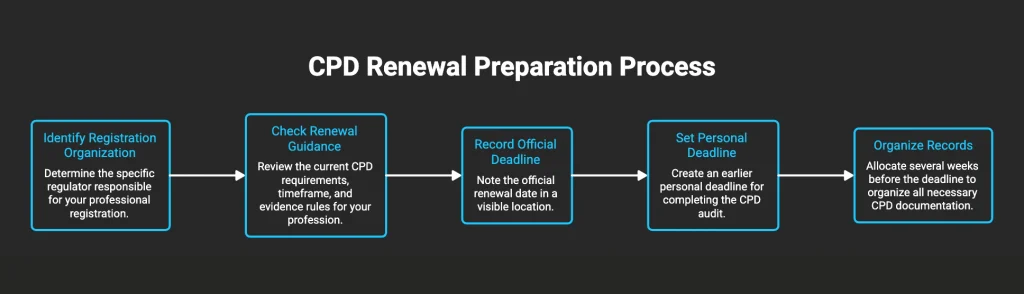
These examples show why healthcare professionals should not assume that another profession’s CPD target applies to them. Your first task should always be to identify the organization responsible for your registration and check its current renewal guidance.
Once you know your deadline, record it somewhere you will see regularly. It is also helpful to create an earlier personal deadline for completing your CPD audit. If your official renewal date is approaching, giving yourself several weeks to organize records can make a significant difference.
Start Your CPD Renewal Checklist Early
Once your renewal requirements are clear, begin by gathering your existing CPD records. Do not immediately start searching for another course or calculating your total. First, collect everything you have already completed during the applicable renewal period.
Look through your email, professional development platforms, workplace training records, online course accounts, digital folders, and physical documents. Certificates are often stored separately from activity notes, so checking only one location may give you an incomplete picture.
Create one central CPD record and enter the activities you have completed. Include the activity name, provider, date, duration or points where applicable, and the location of the supporting evidence. If your professional requirements include reflection or other information, leave space for that as well.
This first stage is simply about creating a complete picture. You may discover activities that you had forgotten about or records that were never added to your main CPD log.
Audit Your Completed CPD Activities
After gathering your records, review each activity against the requirements that apply to your professional registration. This is where your CPD renewal checklist becomes more than a simple count of hours or points.
For every activity, check when it was completed, whether it falls within the correct renewal period, what type of learning it involved, and whether it is relevant to your professional requirements. Then check whether you have enough evidence to demonstrate that you completed it.
Do not assume that every activity automatically qualifies simply because it was described as CPD by a course provider. The rules for acceptable learning can differ between regulators and professional bodies. If there is any uncertainty, check the applicable guidance before relying on the activity as part of your renewal record.
It is also worth checking for duplicate entries. The same workshop may have been recorded through workplace training and your personal CPD log, for example. Removing duplicates gives you a more accurate picture of your actual progress.
The goal of this audit is to separate three things: CPD you completed, CPD that can be counted under your applicable requirements, and CPD for which you have sufficient evidence.
Identify Your CPD Gaps
Once your completed activities have been audited, identify what is genuinely missing. Avoid writing a vague note such as “need more CPD.” Instead, define the exact gap.
You may be short of a required number of hours or points, missing a particular type of learning, lacking a required reflection, or simply missing documentation for activities you already completed.
This distinction matters. If you have already completed enough eligible CPD but cannot find one certificate, your problem is documentation rather than learning. If your records show a genuine shortfall, however, you may need to complete additional relevant activities before the deadline.
Review your regulator’s requirements before deciding what to do next. This prevents you from spending time and money on learning that may not satisfy the specific requirement you need to meet.
If you want to revisit how CPD hours and points are measured before completing your audit, see CPD Points and CPD Hours Explained: How Many Do You Actually Need?
CPD Documentation Requirements: What Should You Keep?
Completing CPD is only part of the renewal process. You also need to be able to demonstrate what you completed and, where required, how the activity relates to your professional practice.
The exact CPD documentation requirements depend on the applicable regulator or professional body. However, useful records can include course certificates, attendance confirmations, activity logs, dates, duration, provider details, learning outcomes, reflective notes, and other supporting evidence.
For example, the UK NMC requires its registrants to maintain accurate CPD records containing information such as the CPD method, topic and relevance to practice, dates, hours, and evidence of the activity.
This is why saving only the final certificate may not always be enough. A certificate can confirm that you completed an activity, while a CPD log can provide the wider context needed to understand your learning record.
Reflection can also be important where your professional requirements call for it. Rather than writing a generic statement for every course, briefly explain what you learned, why it was relevant to your role, and how it may influence your practice.
The best time to record this information is immediately after completing the activity. Trying to remember the details several months later can make your CPD record less accurate and much harder to maintain.
Organize Your CPD Records for Easy Retrieval
A good CPD record should not only contain the right information; it should also be easy to find.
Create a simple folder structure for your renewal period and use consistent file names for certificates and supporting evidence. You could organize documents by year, renewal cycle, professional category, or another system that makes sense for your work.
Your spreadsheet or tracking document should point to the location of the supporting evidence. This means that when you review one activity, you should be able to find its certificate or other documentation without searching through your entire email history.
It is also useful to keep a backup of important records. Losing a certificate because it was stored on an old computer or an inaccessible email account can create unnecessary problems close to renewal.
If your professional body provides a CPD log, template, or portfolio format, consider using it as the foundation for your own tracking system. A standard template can help you capture the information you are most likely to need.
Prepare for a CPD Audit
Renewal preparation should include a quick audit of your own records before you submit anything. Think of this as a final quality check.
Open your CPD record and ask whether another person could understand what you completed without needing you to explain every entry. Check that dates are accurate, activities are recorded under the correct renewal period, supporting evidence is available, and required reflections or other records are complete.
Some regulators may select professionals for CPD audits. For example, the HCPC randomly selects 2.5% of registrants in each profession for CPD audit during renewal and asks selected professionals to provide a CPD profile and supporting evidence.
Being prepared for an audit does not mean creating unnecessary paperwork. It means maintaining a record that clearly connects your learning activities with the evidence supporting them.
Common CPD Renewal Mistakes
One of the most common mistakes is waiting until the renewal deadline is close before reviewing CPD records. This can leave little time to recover missing evidence or complete relevant learning.
Another mistake is focusing only on the total number of points or hours. A total figure may not tell the whole story if your professional requirements include specific categories, learning methods, reflections, or evidence.
Assuming that every course automatically counts can also cause problems. Before relying on an activity, check whether it is relevant and acceptable under the rules that apply to your registration.
Poor documentation is another avoidable issue. A professional may have completed valuable learning but struggle to demonstrate it because certificates were lost or activity details were never recorded.
Finally, avoid using old renewal information without checking whether it still applies. Professional requirements can vary between registration periods, and guidance should be checked against the current rules.
What to Do If You Are Short on CPD Points
If your renewal deadline is approaching and your records show a genuine shortfall, start by checking your existing documentation again. It is possible that completed activities have not been added to your main record or that evidence is stored somewhere you did not initially check.
Once you know the exact gap, review the current requirements and identify learning activities that are relevant and eligible. Avoid choosing a course simply because it promises a particular number of CPD points or hours. The important question is whether the activity meets the requirements that apply to your professional registration.
If time is limited, prioritize activities that are clearly relevant, properly documented, and permitted under your applicable rules. Keep the evidence as soon as each activity is completed rather than leaving documentation until the end.
If you believe you cannot meet the requirements before your deadline, contact the relevant regulator or professional body as soon as possible. Some organizations have procedures for specific circumstances, but these vary and should never be assumed to apply automatically.
The aim is not to collect as many points as possible at the last minute. The aim is to resolve the specific requirement that remains outstanding while keeping your renewal record accurate and defensible.
Use Tools and Templates to Track CPD All Year
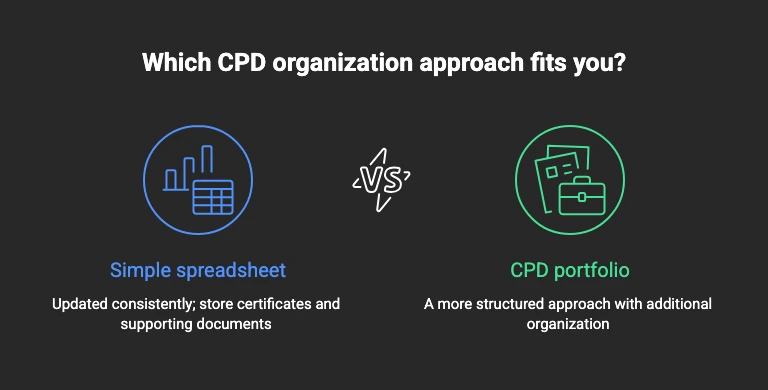
You do not need an expensive system to keep your CPD organized. A simple spreadsheet can work well if it is updated consistently.
Useful columns can include the activity name, provider, date, learning type, duration or points, relevance to your practice, evidence location, and reflection status. You can also add a column showing whether the activity has been fully documented.
A digital folder can then store the corresponding certificates and supporting documents. When a new activity is completed, update the spreadsheet and save the evidence at the same time.
For professionals who prefer a more structured approach, a CPD portfolio or professional development platform can provide additional organization. The important factor is not the tool itself but whether it helps you maintain an accurate, accessible record throughout the renewal period.
A calendar can also become part of your CPD system. Set reminders for monthly or quarterly reviews instead of waiting for the renewal deadline. During each review, check your progress, update missing records, and confirm that your evidence is stored correctly.
Build a System That Makes the Next Renewal Easier
Once your current renewal is complete, do not archive everything and forget about CPD until the next deadline. Keep the same tracking system active for the next cycle.
At the beginning of a new period, record your new deadline and applicable requirements. After every learning activity, add it to your record and save the evidence. Every few months, review your progress and address any documentation gaps while they are still easy to resolve.
This approach changes renewal from a large task into a series of small routine actions. Instead of spending several days reconstructing your professional development history, you can simply review a record that has been maintained throughout the year.
A year-round system also makes it easier to plan meaningful professional development. Rather than taking random courses because a deadline is approaching, you can identify areas where additional learning would genuinely support your role and professional goals.
Your Final CPD Renewal Check
Before submitting your renewal, take one final look at the complete record. Confirm that you have checked the current requirements, recorded the correct deadline, reviewed all completed activities, identified any genuine gaps, and confirmed that your learning is eligible where applicable.
Then check your evidence. Make sure certificates and supporting documents are available, activity details are accurate, and any required reflective records have been completed. If your professional body uses a specific renewal portal, form, declaration, or submission process, complete each required step before the deadline.
Finally, save a copy of your completed renewal record and supporting evidence in a location you can access during the next cycle. Keeping your previous records organized can make future renewals much easier.
Stay Ready for Your Next CPD Renewal
CPD renewal becomes much more manageable when preparation starts before the deadline. By understanding your renewal cycle, auditing your completed activities, identifying genuine gaps, maintaining the right documentation, and reviewing your records throughout the year, you can reduce last-minute pressure and stay better prepared.
If you need additional learning to support your professional development or meet an applicable CPD requirement, explore accredited CPD courses that align with your professional role and renewal needs. Start building your next cycle of learning today so your next renewal does not become a last-minute task.