
Continuing Professional Development (CPD) is an essential part of maintaining professional competence across regulated industries. Doctors update their clinical knowledge, lawyers keep pace with changes in legislation, financial professionals stay current with regulatory requirements, and engineers develop their technical skills as standards and technologies evolve.
The principle is shared across these professions, but the consequences of outdated knowledge can differ significantly.
A gap in professional knowledge in finance may contribute to financial or compliance risks. In law, outdated knowledge can affect the quality of professional advice. In engineering, failing to keep up with technical or safety standards can create risks for projects and the public. In healthcare, however, professional knowledge is applied directly to decisions concerning people’s health and wellbeing.
That makes the comparison of CPD healthcare vs other industries particularly important. Healthcare is not the only high-stakes profession, nor can it simply be described as the most strictly regulated industry. Instead, its distinctive challenge lies in the direct connection between professional competence, clinical decisions, and patient care.
What Does CPD Look Like Across Different Industries?
Although CPD requirements vary by profession, country, and regulatory body, the underlying purpose is consistent: helping professionals maintain and develop the knowledge and skills required for their roles.
In healthcare, CPD can involve formal courses, conferences, workshops, online learning, professional reading, clinical education, reflective activities, and learning related to updated guidance and practices. Depending on the profession and jurisdiction, continuing development may also form part of registration, licensing, or renewal requirements.
The legal profession follows a similar principle, although CPD does not always operate through a universal annual-hours model. In some jurisdictions, lawyers are expected to identify their professional development needs and demonstrate that they remain competent in their areas of practice.
Finance also places considerable emphasis on continuing professional education. Professionals in regulated financial roles may need to maintain knowledge of regulations, ethics, products, risk management, and professional responsibilities.
Engineering professionals similarly need to maintain and develop their technical competence. Changes in technology, standards, regulations, safety requirements, and industry practices make continuous learning an important part of professional development.
This demonstrates an important point: CPD is not simply about collecting certificates or completing a fixed number of hours. Its broader purpose is to ensure that professionals remain capable of carrying out their responsibilities effectively.
Why Are the Stakes Particularly High in Healthcare?
The most important distinction in CPD in healthcare vs other industries is the direct relationship between professional competence and patient care.
Healthcare professionals make decisions involving diagnosis, treatment, medication, procedures, monitoring, and patient management. These decisions are made within a constantly developing body of professional knowledge.
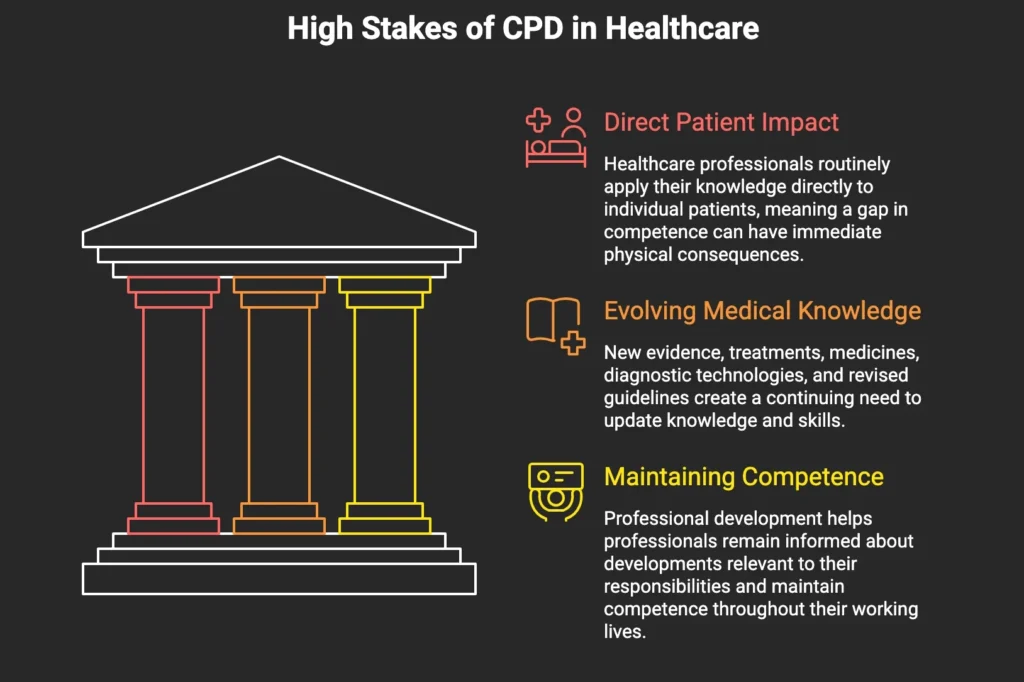
A healthcare qualification provides the foundation for practice, but medical knowledge does not remain static after graduation. New evidence can influence clinical recommendations. Treatments and medicines develop. Diagnostic technologies improve. Guidelines are revised. New health risks and conditions emerge.
This creates a continuing need for healthcare professionals to update their knowledge and skills.
As discussed in Why CPD Matters in Healthcare, professional development is not simply a career requirement. It can help professionals remain informed about developments relevant to their responsibilities and maintain their competence throughout their working lives.
The stakes can therefore be particularly high when professional knowledge becomes outdated. A healthcare professional may hold the necessary qualification but still need to keep their knowledge current to ensure that their practice reflects relevant evidence, guidance, and professional expectations.
However, it would be inaccurate to suggest that healthcare is the only profession where mistakes can have serious consequences. Engineering can involve public safety, financial services can affect individuals and organizations on a large scale, and legal decisions can have significant consequences for people’s rights and finances.
The more precise distinction is that healthcare professionals routinely apply their knowledge directly to individual patients. A gap in competence can therefore have immediate physical consequences for the person receiving care.
The Consequences of Outdated Knowledge Across Industries
The consequences of outdated professional knowledge depend largely on the nature of the work.
In healthcare, outdated knowledge can affect clinical judgment, treatment decisions, medication management, or the application of current guidance. Where an error contributes to patient harm, the consequences can be immediate and potentially irreversible.
This is why CPD should be viewed as more than a compliance exercise. As explored in The Cost of Skipping CPD, failing to maintain professional knowledge can create risks that extend beyond an individual’s career development.
Finance presents a different risk profile. Professionals must keep pace with changing regulations, financial products, market developments, risk requirements, and conduct expectations. Outdated knowledge can contribute to inappropriate decisions, compliance failures, financial losses, enforcement action, or reputational damage.
The legal profession also depends heavily on current knowledge. Legislation, case law, procedural requirements, and professional obligations can change. Lawyers who fail to keep their knowledge current may provide inappropriate advice or fail to meet professional responsibilities.
Engineering brings another dimension to the comparison. Engineers work with technical standards, regulations, technologies, materials, and safety requirements that can evolve over time. Outdated knowledge can contribute to design problems, project failures, financial losses, infrastructure issues, or risks to public safety.
The comparison, therefore, should not be reduced to patient harm versus minor professional mistakes. Other industries can involve extremely serious consequences.
The key difference is the nature and timing of the risk. Healthcare professionals can apply outdated knowledge directly to an individual patient’s care, where the consequences may involve immediate physical harm.
Healthcare Compliance Standards and Professional Regulation
Regulation plays an important role in maintaining professional competence across healthcare and other regulated industries.
In many jurisdictions, healthcare professionals must meet continuing development or competence requirements connected to professional registration. These requirements vary considerably depending on the profession and regulatory system.
For example, healthcare regulators may require professionals to demonstrate continuing competence as part of maintaining registration or meeting professional obligations. The exact requirements are not universal, making it important for professionals and organizations to understand the rules that apply to their specific profession and jurisdiction.
Other industries also have substantial regulatory requirements.
Legal professionals may have continuing competence obligations imposed by professional regulators. Financial professionals in regulated roles may have specific continuing education requirements covering technical knowledge, regulation, ethics, and professional conduct. Engineering professionals may also be expected to demonstrate ongoing professional development as part of maintaining professional competence or registration.
This makes a meaningful CPD regulatory comparison more complex than simply asking which industry has the strictest requirements.
Healthcare should not automatically be described as more regulated than finance, law, or engineering. Instead, its regulatory environment is distinctive because professional competence can be closely connected to registration and the responsibility to provide patient-facing care.
For organizations operating in healthcare, healthcare compliance standards should therefore be approached as part of a broader professional competence strategy rather than as a simple checklist.
Completing a CPD activity is only one part of the process. The learning should be relevant to the professional’s responsibilities, appropriately documented, and useful for maintaining or developing competence.
The Speed of Change in Healthcare
Another factor that makes continuous professional development particularly important in healthcare is the ongoing development of clinical knowledge.
New treatments can influence how conditions are managed. Medicines can change the options available to patients. Diagnostic technologies can introduce new approaches to identifying and monitoring conditions. Research can challenge established practices, while updated guidelines can change professional recommendations.
Healthcare professionals therefore need mechanisms for staying informed throughout their careers.
However, healthcare is not the only industry experiencing rapid change.
Financial services continue to evolve alongside new technologies, regulations, products, and risks. Engineering changes with new materials, technologies, sustainability requirements, and technical standards. Legal professionals must respond to new legislation, court decisions, procedures, and emerging areas of law.
The issue is not simply that healthcare changes faster than every other profession.
Rather, healthcare combines a changing knowledge base with direct clinical application. Professionals must not only understand new information but determine how relevant developments affect the way they work with patients.
This makes timely, relevant CPD particularly valuable.
What Can Other Industries Learn From Healthcare?
Healthcare offers several useful lessons for professional development across other sectors.
Connecting Learning to Real-World Practice
One important principle is the connection between learning and professional responsibilities. CPD becomes more valuable when professionals can apply new knowledge to the situations they encounter in their work.
This approach can benefit finance, law, engineering, and other regulated professions. Rather than focusing exclusively on the number of completed courses, organizations can consider whether learning addresses genuine competency needs.
Making Learning Reflective
Healthcare also places value on reflection and professional improvement. Professionals can consider what they have learned, why it matters, and how it should influence their future practice.
This principle can be adapted across industries to make CPD more meaningful and outcome-focused.
Maintaining Evidence of Development
Documenting professional development is another valuable practice. Maintaining appropriate records can help professionals monitor their learning, identify development needs, and demonstrate their commitment to ongoing competence when required.
These principles can help shift CPD from a purely administrative requirement toward a tool for professional performance.
What Can Healthcare Learn From Other Industries?
The exchange should work both ways.
Healthcare can also learn from the more flexible and technology-enabled approaches emerging across professional education.
Digital learning platforms can make CPD more accessible to professionals working demanding schedules. Online modules, microlearning, workplace-based learning, digital assessments, skills tracking, and streamlined credential verification can reduce some of the practical barriers associated with professional development.
This is particularly relevant in healthcare, where professionals must balance continuing education with patient-facing responsibilities and administrative demands.
Technology can also make it easier to organize and document professional development. Digital systems can help professionals access relevant learning, maintain records, monitor development needs, and verify completed credentials.
However, flexibility should not mean lowering professional standards.
The opportunity is to combine healthcare’s strong emphasis on competence, accountability, and patient safety with the accessibility and efficiency of modern CPD models.
Moving Beyond CPD Compliance
The comparison between healthcare and other industries demonstrates that there is no single model for effective professional development.
Finance, law, engineering, and healthcare all require professionals to maintain their competence, but their responsibilities and risk environments differ. Their CPD systems therefore need to reflect the realities of each profession.
Healthcare carries particularly high stakes because professional knowledge is applied directly to patient care. Maintaining current knowledge is therefore closely connected to professional responsibility and the ability to provide appropriate care.
At the same time, healthcare can benefit from innovations developed elsewhere. Flexible learning formats, digital delivery, competency tracking, and efficient verification can make CPD easier to integrate into professional life without compromising its purpose.
Ultimately, the goal of CPD should extend beyond answering:
“How many hours have been completed?”
A more meaningful question is:
“Does this learning help the professional remain competent for the responsibilities they carry?”
For healthcare professionals, those responsibilities can reach directly to the wellbeing and safety of the patient.
To explore structured professional development and continuing competence in healthcare, learn more about healthcare-specific CPD standards