
Healthcare professionals work in an environment where knowledge, technology, guidelines, and professional expectations continue to evolve. Yet, with demanding schedules, long shifts, administrative responsibilities, and patient-care priorities, continuing professional development (CPD) can easily be pushed to the bottom of the list.
The problem is that postponing CPD can create challenges that become harder to address later. Depending on the profession, employer, and regulatory jurisdiction, healthcare professionals may have specific CPD requirements to meet or demonstrate. Failing to understand those requirements, complete relevant learning, or maintain appropriate evidence can create unnecessary compliance and professional-development risks.
CPD should therefore be treated as an ongoing professional responsibility rather than something to complete shortly before a renewal deadline. Understanding the consequences of falling behind—and knowing how to recover—can help healthcare professionals stay prepared and maintain a reliable record of their development.
Why Healthcare Professionals Fall Behind on CPD
Falling behind on CPD does not necessarily mean that a professional does not value learning. In many cases, it is the result of practical pressures.
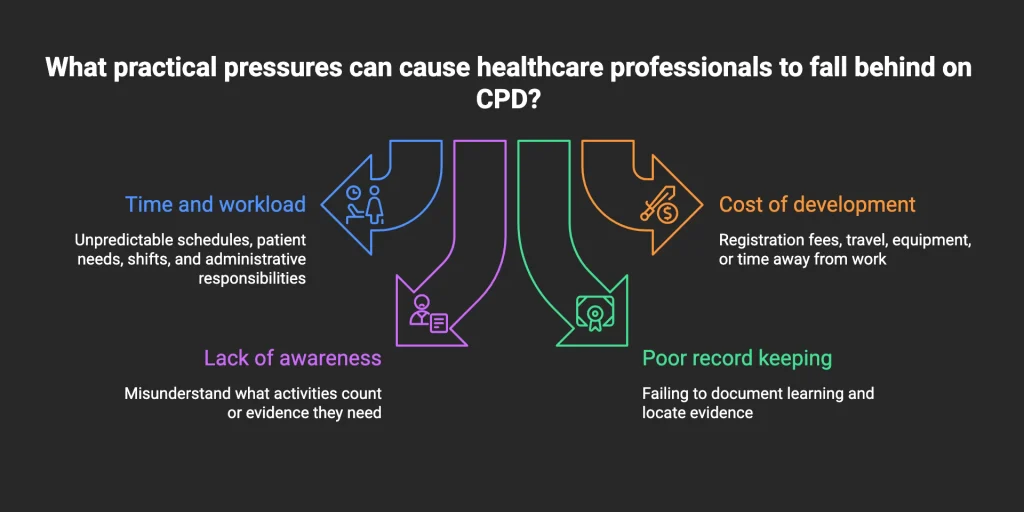
Time and Workload
Healthcare professionals often work around unpredictable schedules, patient needs, shifts, and administrative responsibilities. Finding dedicated time for structured learning can therefore be difficult.
When CPD is not planned throughout the year, professionals may continue postponing activities until a renewal or reporting deadline approaches.
Cost of Professional Development
Some CPD activities require registration fees, travel, equipment, or time away from work. For professionals paying for their own development, cost can become another barrier.
However, choosing CPD based solely on price can also create problems. A low-cost course may not necessarily provide the learning outcomes, assessment, relevance, or recognition that a professional actually needs.
Lack of Awareness
CPD requirements can differ between healthcare professions, professional bodies, employers, and countries. Professionals who do not regularly check their applicable requirements may misunderstand what activities count, how they should be recorded, or what evidence they need to retain.
Poor Record Keeping
Another common problem is completing learning but failing to document it properly.
Certificates, attendance records, reflective notes, assessments, and other evidence can become difficult to locate when they are stored across emails, paper files, different devices, or multiple platforms.
This is why CPD management involves more than simply completing learning activities. Professionals also need a reliable system for recording and retaining evidence.
What Happens When CPD Requirements Are Not Met?
There is no single consequence that applies to every healthcare professional. CPD requirements and enforcement mechanisms depend on the relevant profession, regulator, employer, and jurisdiction.
Where CPD forms part of a professional or registration requirement, failing to meet the applicable requirements may create difficulties during renewal, audit, or compliance review.
Difficulty Demonstrating Compliance
One of the most immediate problems can be the inability to demonstrate that required professional development has been completed.
A professional may have undertaken useful learning but still face difficulties if appropriate evidence has not been retained.
This makes documentation an important part of CPD management.
Audits and Reviews
Some professional bodies use audits or review processes to assess whether registrants have met their CPD obligations. Where a professional is selected for review, they may need to provide evidence of their learning and explain how their CPD relates to their professional practice.
The specific audit process differs between regulators, so healthcare professionals should always check the requirements that apply to their profession.
Renewal and Registration Requirements
For some healthcare professions, CPD may form part of wider requirements associated with maintaining professional registration or completing a renewal process.
However, professionals should not assume that missing CPD automatically results in suspension, cancellation, or loss of a licence. The actual consequences depend on the rules established by the relevant regulatory authority.
The safest approach is to check the current requirements directly with the applicable regulator or professional body.
The Career Consequences of Neglecting CPD
CPD is not only about satisfying a requirement. It can also contribute to maintaining knowledge, developing skills, and demonstrating an ongoing commitment to professional development.
When CPD is consistently neglected, several professional challenges may arise.
Falling Behind Changes in Healthcare
Healthcare practices, technologies, guidelines, and professional expectations can change rapidly. Professionals who do not engage in relevant learning may have fewer opportunities to update their knowledge.
Regular CPD provides a structured way to identify knowledge gaps and stay connected with developments relevant to a person’s role.
Difficulty Demonstrating Professional Development
A well-maintained CPD record can provide evidence of learning and development over time.
This can be particularly useful when professionals need to demonstrate their development to employers, professional bodies, or regulators.
Without appropriate records, it can be difficult to show what learning has taken place, even when informal learning has occurred.
Potential Impact on Career Development
CPD alone does not guarantee promotion, higher earnings, or career progression. However, professional development can form part of the wider evidence used to demonstrate knowledge, skills, commitment, and readiness for changing responsibilities.
The career value of CPD therefore comes from choosing relevant learning and applying it meaningfully not simply accumulating certificates.
Institutional Risks of Poor CPD Tracking
CPD is also an organizational responsibility. Healthcare institutions need to understand whether their staff have access to appropriate training and whether required learning is being documented.
Difficulty Monitoring Staff Development
Without a consistent tracking process, organizations may struggle to identify:
- Which employees have completed required training
- Which staff members have outstanding learning requirements
- When certificates or training records need updating
- Where competency gaps may exist
- Whether evidence can be produced during an audit or review
A centralized approach to CPD tracking can make this information easier to manage.
Compliance and Audit Challenges
Healthcare organizations may need to demonstrate that staff development and training requirements are being managed appropriately.
Incomplete records can make this process more difficult. Even when employees have completed training, missing documentation may prevent an organization from quickly demonstrating what has been completed.
Quality and Competency Considerations
Professional development also has a broader relationship with workforce competency.
Healthcare organizations operate in environments where maintaining current knowledge and skills is important. A structured CPD process can help organizations identify learning needs and support continuous professional development across their workforce.
The exact regulatory and accreditation implications vary between healthcare systems, so organizations should follow the requirements of their relevant authorities.
What CPD Non-Compliance Can Look Like
The following examples are hypothetical scenarios designed to illustrate common CPD-management problems. They are not descriptions of specific real-world cases.
Scenario 1: The Busy Healthcare Professional
A healthcare professional spends most of the year managing demanding clinical responsibilities and postpones CPD activities.
Several months later, a renewal deadline approaches and the professional discovers that the required learning has not been completed.
The issue is no longer simply finding an interesting course. The professional now needs to identify the applicable requirements, determine the gap, find relevant learning opportunities, and organize the necessary evidence within a limited period.
Scenario 2: The Missing Evidence
Another professional regularly attends webinars, workshops, and professional-development sessions but does not keep their certificates and learning records organized.
When asked to demonstrate their CPD activity, they remember completing the training but cannot easily produce the supporting evidence.
This illustrates an important distinction: completing CPD and being able to demonstrate CPD are not always the same thing.
Scenario 3: The Organization Without a Tracking System
A healthcare organization encourages employees to undertake professional development but has no consistent system for recording participation.
Different departments maintain separate spreadsheets, emails, and paper records.
When management needs an overview of staff training, it becomes difficult to determine who has completed specific activities and where gaps remain.
A structured tracking process could make CPD management more transparent and easier to monitor.
How to Recover If You Have Fallen Behind on CPD
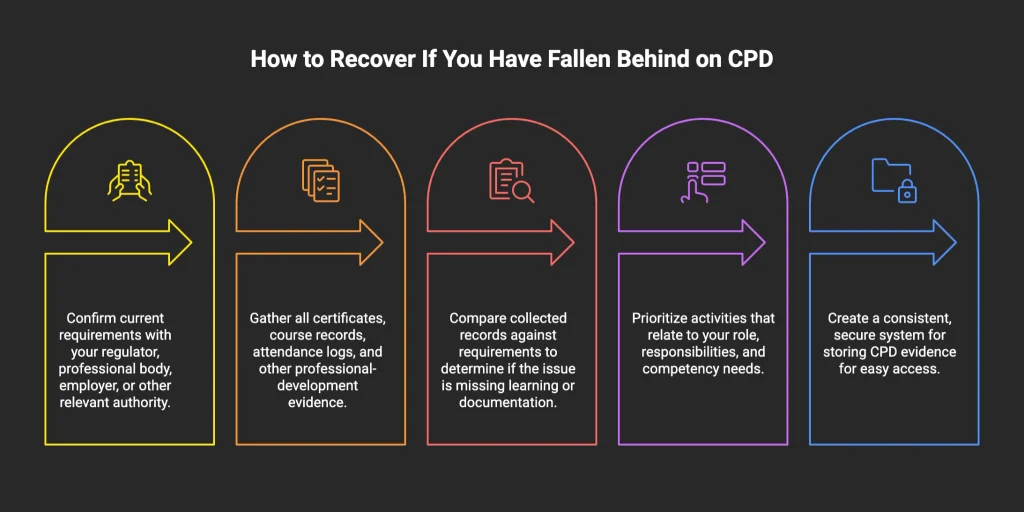
Discovering a CPD gap does not mean the situation should be ignored. The first step is to understand exactly what is missing.
1. Check Your Current Requirements
Start with the regulator, professional body, employer, or other authority relevant to your role.
Confirm the current requirements rather than relying on information from previous renewal periods or another profession.
2. Review Your Existing CPD Records
Gather everything you already have:
- Certificates
- Course completion records
- Attendance records
- Webinar confirmations
- Reflective learning records
- Workshop documentation
- Relevant professional-development evidence
You may discover that some activities have already been completed but were simply not properly organized.
3. Identify the Actual Gap
Once your records are collected, compare them with the requirements that apply to you.
Determine whether the problem is:
- Missing learning
- Missing documentation
- Incorrectly recorded activities
- Insufficient relevant learning
- A combination of these issues
This prevents you from spending time completing unnecessary activities.
4. Choose Relevant CPD
If additional learning is required, prioritize activities that relate to your role, responsibilities, competency needs, and applicable requirements.
The objective should not simply be to collect the maximum number of points as quickly as possible.
For a clearer understanding of CPD points and how they are generally used, link to CPD Points Explained.
5. Keep Evidence Going Forward
Once the gap has been addressed, create a consistent system for storing your CPD evidence.
Keep certificates and supporting documentation somewhere secure and easy to access when needed.
How to Prevent Future CPD Gaps
Recovering from a CPD gap is usually more difficult than managing development consistently throughout the year. A few simple habits can make CPD easier to maintain.
Create an Annual CPD Plan
At the beginning of the relevant CPD period, identify your professional-development priorities.
Consider your current role, competency requirements, areas where your knowledge needs updating, and any mandatory learning that applies to you.
Schedule CPD Regularly
Instead of waiting until a renewal deadline, spread learning activities throughout the year.
Even smaller, regular learning activities can make CPD easier to manage than trying to complete everything at once.
Record Learning Immediately
After completing a course, workshop, webinar, or other activity, record it while the details are still fresh.
Include the date, provider, topic, learning outcomes, and supporting evidence where appropriate.
Review Your Progress
Set aside time periodically to review your CPD record.
A quarterly review, for example, can help identify gaps early rather than discovering them immediately before a deadline.
Choose Quality Over Quantity
The purpose of CPD is not simply to accumulate certificates.
Choose learning that addresses genuine professional-development needs and contributes to your knowledge, skills, or practice.
Where relevant, accredited CPD courses can provide a structured option for professionals looking for recognized learning opportunities.
For practical guidance on managing the renewal process, link to CPD Renewal Made Simple.
CPD Should Be More Than a Compliance Exercise
The most effective approach to CPD is to view it as an ongoing professional-development process rather than a deadline-driven obligation.
Healthcare professionals can use CPD to identify knowledge gaps, keep their skills current, reflect on their practice, and prepare for changes within their profession.
Organizations can also use structured CPD systems to understand workforce development needs, maintain appropriate records, and support continuous learning.
The key is consistency. A CPD record built gradually throughout the year is generally easier to maintain than one reconstructed at the last minute.
So…
Skipping or postponing CPD can create unnecessary challenges for healthcare professionals, particularly where continuing professional development forms part of professional, employer, or regulatory requirements.
The risks are not identical for everyone. They depend on the profession, jurisdiction, regulator, employer, and specific requirements that apply. What is consistent, however, is the value of understanding those requirements and maintaining accurate evidence of professional development.
If you have fallen behind, start by checking your requirements, reviewing your records, identifying the actual gap, completing relevant learning, and keeping evidence organized. Going forward, regular planning and tracking can help prevent CPD from becoming a last-minute problem.