
Nursing does not end with completing a qualification. Healthcare continues to change, and nurses are expected to keep their professional knowledge, clinical skills, and understanding of current practices up to date. New treatments, technologies, medicines, procedures, and professional standards can all affect everyday nursing practice.
This is why Continuing Professional Development, or CPD, is an important part of a nursing career. For many nurses, CPD is not only a way to improve professionally but also a requirement connected to registration, renewal, or revalidation.
Understanding nursing CPD requirements can sometimes be difficult. Different countries and regulatory authorities have different rules about the number of hours or points required, the activities that can be counted, and the evidence nurses need to maintain. Choosing appropriate learning and keeping accurate records are therefore essential.
A well-organized approach can make CPD much easier. By understanding the requirements early, selecting relevant professional learning, and maintaining proper documentation, nurses can stay prepared throughout their registration cycle.
Understanding CPD Requirements for Nurses
Continuing Professional Development is the ongoing process of developing professional knowledge, skills, competence, and experience after initial education and qualification.
For nurses, CPD can involve learning directly related to clinical practice as well as broader professional development. Topics may include patient safety, infection prevention, medication management, communication, leadership, healthcare technology, clinical procedures, and other areas relevant to a nurse’s role.
The purpose of CPD is not simply to collect certificates. Effective professional development should help nurses identify learning needs, update their knowledge, strengthen relevant skills, and apply what they learn to their practice.
However, nursing CPD requirements are not the same worldwide. The professional regulator responsible for a nurse’s registration determines the specific requirements that apply in that jurisdiction. Nurses should therefore always check the current guidance provided by their relevant regulatory authority.
How Many CPD Hours or Points Do Nurses Need?
There is no universal number of CPD hours or points that applies to every nurse.
Requirements can differ according to the country, regulatory authority, registration category, and renewal system. Some regulators establish annual requirements, while others measure CPD across a longer registration or revalidation period. Some use hours, while others use points, credits, or specific learning requirements.
For example, nurses registered with the UK’s Nursing and Midwifery Council currently need to complete 35 hours of CPD during the three years before revalidation, including at least 20 hours of participatory learning. The CPD must contribute to the nurse’s professional development.
This example should not be treated as a worldwide standard. A nurse registered under another regulatory system may have completely different requirements.
Before beginning a CPD plan, nurses should identify their regulatory authority, understand the applicable CPD requirement, and note the relevant renewal or revalidation date.
It is also important to check whether the requirement has changed since the previous registration cycle. Professional regulators can update their standards, making current guidance more reliable than relying on information from previous years.
Understanding CPD Hours, Points, and Credits
CPD may be measured using hours, points, credits, or other systems.
A CPD hour generally refers to time spent completing a learning activity, while CPD points or credits may be assigned according to a particular educational framework. These terms should not automatically be treated as interchangeable.
A course provider may advertise a program as offering a certain number of CPD hours or points, but that does not necessarily mean those hours will satisfy every nursing regulator’s requirements.
This is particularly important when nurses complete online courses or programs provided by organizations in another country. A course can be professionally useful without automatically being accepted for registration renewal.
Nurses should therefore check the learning activity against the requirements of their own regulator before counting it toward their CPD obligation.
What CPD Activities Can Nurses Complete?
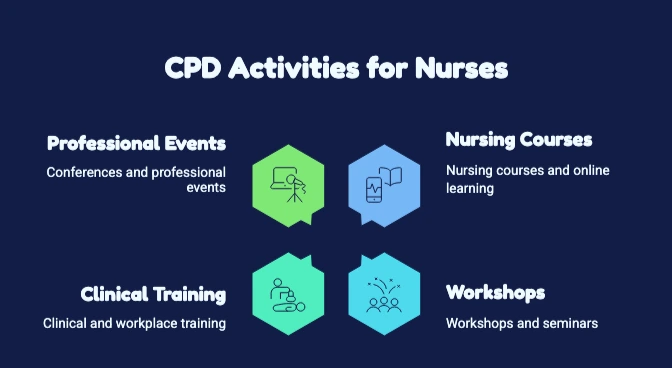
Nursing CPD can take many forms. The activities accepted depend on the applicable professional framework, but common examples include professional courses, workshops, seminars, conferences, online learning, clinical training, workplace learning, professional discussions, and other structured educational activities.
The most appropriate activities are those that address genuine professional learning needs and are relevant to the nurse’s scope of practice.
Nursing Courses and Online Learning
Courses are one of the most accessible ways for nurses to develop professional knowledge.
Online CPD courses can be particularly convenient for nurses working different shifts or managing demanding schedules. They may cover clinical subjects, patient care, professional standards, leadership, communication, technology, or other areas of nursing practice.
When choosing an online course, nurses should consider more than the title. Look at the learning outcomes, course content, duration, assessment methods, evidence of completion, and recognition status.
Most importantly, confirm whether the learning activity meets the requirements of the relevant nursing regulator if it is intended to contribute toward registration or renewal.
Workshops and Seminars
Workshops provide opportunities for nurses to learn through presentations, discussion, demonstrations, and practical activities.
They can be particularly valuable when a nurse wants to explore a specific professional issue or develop practical knowledge in a focused setting.
Seminars, professional meetings, and educational sessions can also contribute to CPD where they meet the applicable requirements.
For nurses whose regulatory framework includes participatory learning, interactive activities can be particularly relevant. The NMC, for example, includes conferences, workshops, relevant training courses, and professional group meetings among examples of participatory learning.
Clinical and Workplace Training
Clinical training allows nurses to develop or refresh skills that are directly connected to their professional responsibilities.
Workplace learning may cover clinical procedures, infection prevention, equipment, patient safety, communication, medicines, or other areas relevant to the healthcare environment.
However, nurses should not assume that every workplace training session automatically qualifies for every CPD requirement. The relevant regulatory guidance should always be checked.
Conferences and Professional Events
Conferences, professional meetings, seminars, and educational events can expose nurses to new developments in healthcare and provide opportunities to learn from other professionals.
These activities may be particularly useful for nurses who want to stay informed about developments beyond their immediate workplace.
Evidence of attendance and participation should be retained where required.
Choosing Quality CPD for Nursing
Finding a course is easy. Finding a quality CPD opportunity that is relevant, structured, and appropriate for professional development requires more consideration.
Before enrolling in a program, nurses should examine the provider and qualification carefully. Clear learning outcomes, relevant subject matter, appropriate learning methods, qualified educators, assessment processes, and reliable evidence of completion can all help indicate that a program has been properly structured.
Recognized CPD providers can offer an additional point of reference when nurses are comparing professional learning opportunities. Provider recognition focuses on the organization delivering the learning and can provide information about its professional learning framework and quality processes.
However, provider recognition and qualification recognition are not necessarily the same thing.
A provider may offer several different courses, but recognition of the provider does not automatically mean that every individual course has received separate recognition. Nurses should therefore look at the specific qualification or learning program where applicable.
Understanding Recognized CPD Qualifications
A recognized CPD qualification can provide useful information about the structure and professional relevance of a particular learning program.
When evaluating a qualification, nurses can consider whether the program has clearly defined learning outcomes, appropriate educational methods, relevant subject content, assessment arrangements, and evidence of completion.
This is particularly helpful when there are many online courses available and it is difficult to distinguish between structured professional learning and programs with limited information about their educational framework.
Recognition can provide additional transparency, but nurses should understand its limits.
A qualification recognized within a CPD framework does not automatically mean that every nursing regulator has approved it for registration or renewal. Nurses remain responsible for checking whether the activity meets the requirements of their own professional authority.
This distinction allows nurses to make informed decisions without confusing CPD recognition with professional licensing or regulatory approval.
Verifying CPD Credentials
Documentation is an important part of professional development.
When a nurse completes a CPD activity, evidence such as a certificate, attendance record, course completion record, or other relevant documentation may need to be retained.
Credential verification can provide an additional layer of transparency by allowing a professional learning record to be checked against the information held by the relevant recognition or verification system.
For nurses, this can be useful when maintaining a professional portfolio or presenting evidence of completed learning.
However, verification should not be confused with regulatory approval. Verification confirms the status or authenticity of a particular credential within the applicable system; it does not automatically establish that a nursing regulator has accepted the qualification for registration purposes.
Nurses should therefore retain their own documentation and follow the evidence requirements specified by their regulator.
When Should Nurses Complete Their CPD?
CPD should be treated as an ongoing activity rather than something to complete immediately before renewal.
The renewal or revalidation period depends on the applicable regulatory system. For example, the NMC currently uses a three-year revalidation cycle for nurses in the UK. Other countries and regulatory authorities may use different periods and requirements.
Once the relevant cycle is known, nurses should plan their learning across the available time.
Completing CPD gradually has several advantages. It reduces last-minute pressure, gives nurses more opportunities to choose relevant learning, and makes it easier to maintain accurate records.
A nurse can begin by identifying professional development needs, selecting suitable activities, and recording each completed activity immediately.
Regular reviews throughout the registration period can also reveal whether additional learning is needed before the renewal deadline.
Keeping Your CPD Documentation Organized
Good record keeping can make the renewal process significantly easier.
Nurses should keep their CPD evidence in one organized location, whether that is a secure digital folder, professional portfolio, or another system suitable for their needs.
Records may include the name of the activity, provider, date, duration, learning method, certificate, attendance evidence, and details about what was learned.
Some regulators require additional information such as reflections or explanations of how the learning relates to professional practice. Nurses should therefore check the exact documentation requirements that apply to them.
The safest approach is to record information immediately after completing each activity.
Waiting several months can make it difficult to remember important details. Maintaining records as CPD is completed also makes it easier to identify missing evidence before renewal.
Common CPD Tracking Mistakes Nurses Should Avoid
One of the biggest mistakes is leaving CPD until the end of the registration period.
Last-minute learning can create unnecessary stress and may result in nurses choosing courses based on convenience rather than professional relevance.
Another common mistake is assuming that every activity labelled as CPD automatically counts toward a nursing registration requirement. A course may use CPD terminology without necessarily meeting the rules of a particular regulatory authority.
Nurses should also avoid focusing entirely on the number of hours. Completing the required amount is important where a regulator sets a minimum, but professional learning should also address genuine development needs.
Poor documentation is another avoidable problem. Losing certificates, forgetting dates, or failing to record learning hours can make it difficult to demonstrate completed CPD.
Finally, nurses should avoid assuming that recognition of a provider automatically means recognition of every course offered by that provider. Provider recognition and qualification recognition should be considered separately when evaluating professional learning.
Finding Accredited or Recognized CPD Options for Nursing
Nurses have many places to find professional development opportunities, including professional organizations, healthcare institutions, educational providers, training organizations, conferences, and online learning platforms.
When searching for accredited or recognized CPD options, the first step should always be identifying what the relevant nursing regulator requires.
From there, nurses can compare available learning opportunities based on professional relevance, learning outcomes, delivery methods, assessment, documentation, and recognition.
A structured recognition framework can help nurses evaluate whether a provider or qualification has been reviewed against defined professional learning criteria. It can also make it easier to distinguish between a formally structured learning opportunity and a course that simply advertises itself as CPD.
At the same time, nurses should remember that the words “recognized,” “accredited,” and “CPD” can have different meanings depending on the organization using them. Regulatory acceptance should therefore always be confirmed separately.
The safest option is to select learning that is both professionally relevant and appropriately documented, while checking with the responsible nursing authority when there is any uncertainty.
Building a Simple Nursing CPD Plan
Managing CPD does not need to be complicated.
Start by identifying your professional regulator and reviewing its current CPD requirements. Record the relevant renewal or revalidation date and determine how many hours, points, credits, or specific activities are required.
Next, review your current nursing responsibilities and identify areas where additional knowledge or skills could be useful.
Choose a combination of suitable learning activities throughout the registration period. This may include courses, workshops, clinical training, online learning, conferences, or other activities accepted under your professional framework.
After each activity, update your CPD record and save the relevant evidence.
Every few months, review your progress. Check how much CPD you have completed, whether your learning remains relevant to your practice, and whether you need additional activities before renewal.
This simple approach can turn CPD from a stressful deadline into a manageable part of everyday professional development.